

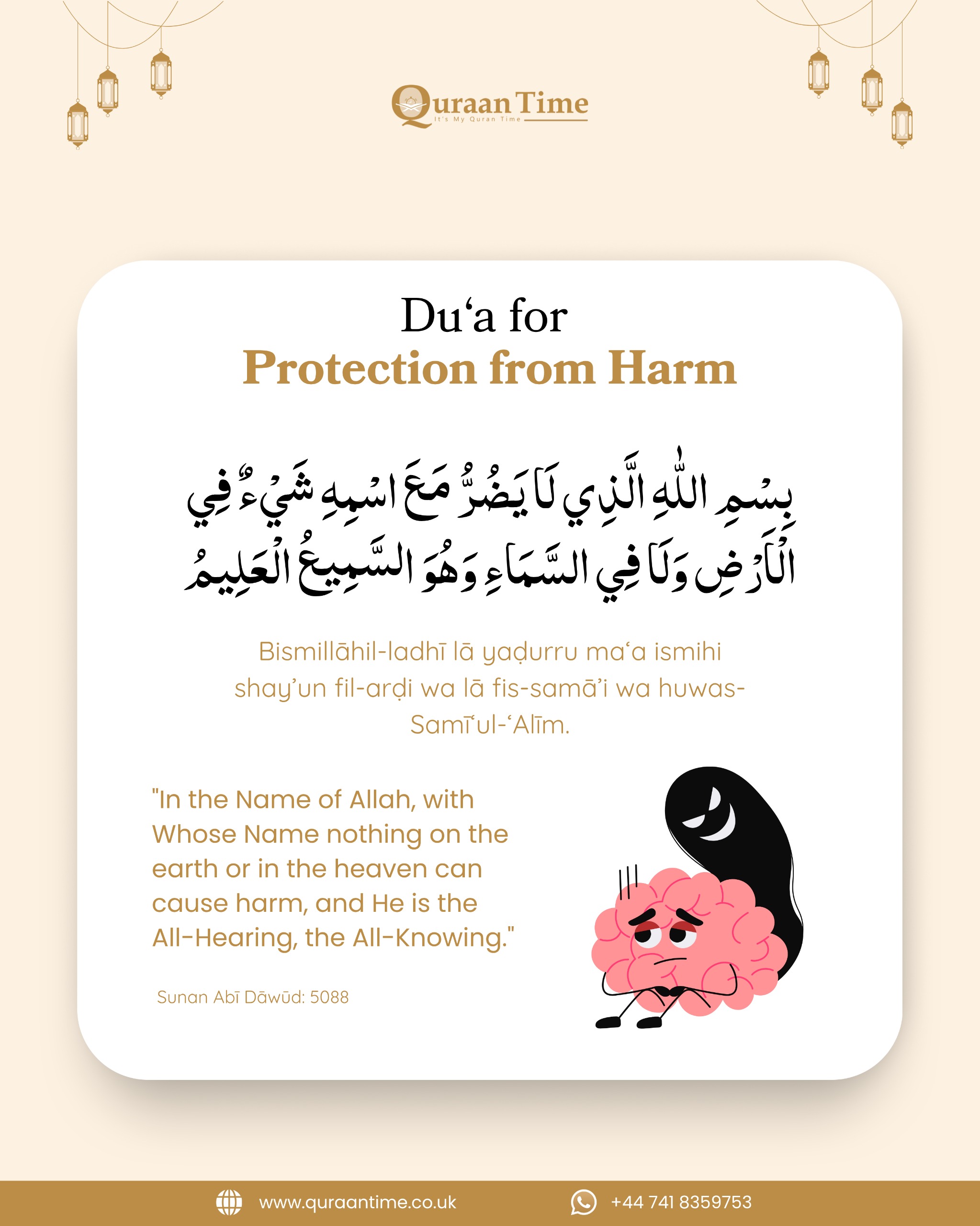
A powerful prophetic supplication that shields you from all evil — morning and evening.
This concise yet profound supplication encompasses tawḥīd (monotheism) and complete reliance upon Allah. By declaring that nothing can cause harm with His Name, the believer acknowledges that all power and protection belong solely to Allah. The mention of “the All-Hearing, the All-Knowing” reinforces that Allah is fully aware of every danger and listens to every plea. Reciting this du‘a in the morning and evening — as recommended by the Prophet ﷺ — acts as a spiritual armor against physical harm, accidents, envy, and unseen calamities.
Scholars explain that the phrase “with whose name nothing can cause harm” does not negate the existence of harmful things; rather, it affirms that no harm can touch a person who sincerely recites this du‘a with presence of heart, except by Allah’s will. It is a declaration that all causes and effects are under divine control.
Practical questions from educators and parents about implementing this du‘a in daily life.
Q: “At what exact times should children recite this du‘a? And is it sufficient to recite it only once?”
A: The Prophet ﷺ encouraged reciting it three times in the morning and three times in the evening. The morning time starts from Fajr until sunrise, and the evening from ‘Asr until sunset. However, if a child misses it, they can recite it at any time — the blessing remains. Consistency matters more than perfection. I also remind my children to recite it before leaving the house or before sleeping, as an extra layer of protection.
Q: “How can we make this du‘a meaningful for young children who don’t understand Arabic?”
A: Wonderful question. I break it down into three steps: First, I tell them the story of how the Prophet ﷺ taught this du‘a to his companions. Then I explain the meaning in simple language — “We say ‘Bismillah’ and Allah keeps us safe from everything that could hurt us.” Finally, I use a reward chart; each time they recite it three times, they get a star. Over time, they internalize the meaning, and the Arabic becomes familiar. Also, I recite it with them every morning during breakfast — it becomes a family ritual.
Q: “Is there a difference between reciting this du‘a for oneself and reciting it for others, like children?”
A: There is no restriction; you can recite it over your children, just as the Prophet ﷺ used to seek protection for his grandsons. I often place my hand on my child’s head and recite it three times, then blow gently (as per the sunnah). I also teach older children to recite it for their younger siblings. It fosters a sense of care and spiritual responsibility. The du‘a is a gift that keeps on giving — it protects the reciter and those they make du‘a for.
Click the button below to simulate a morning recitation — each click counts as one recitation. After three clicks, you will receive a virtual confirmation. (Fun for kids and a gentle reminder for adults.)