
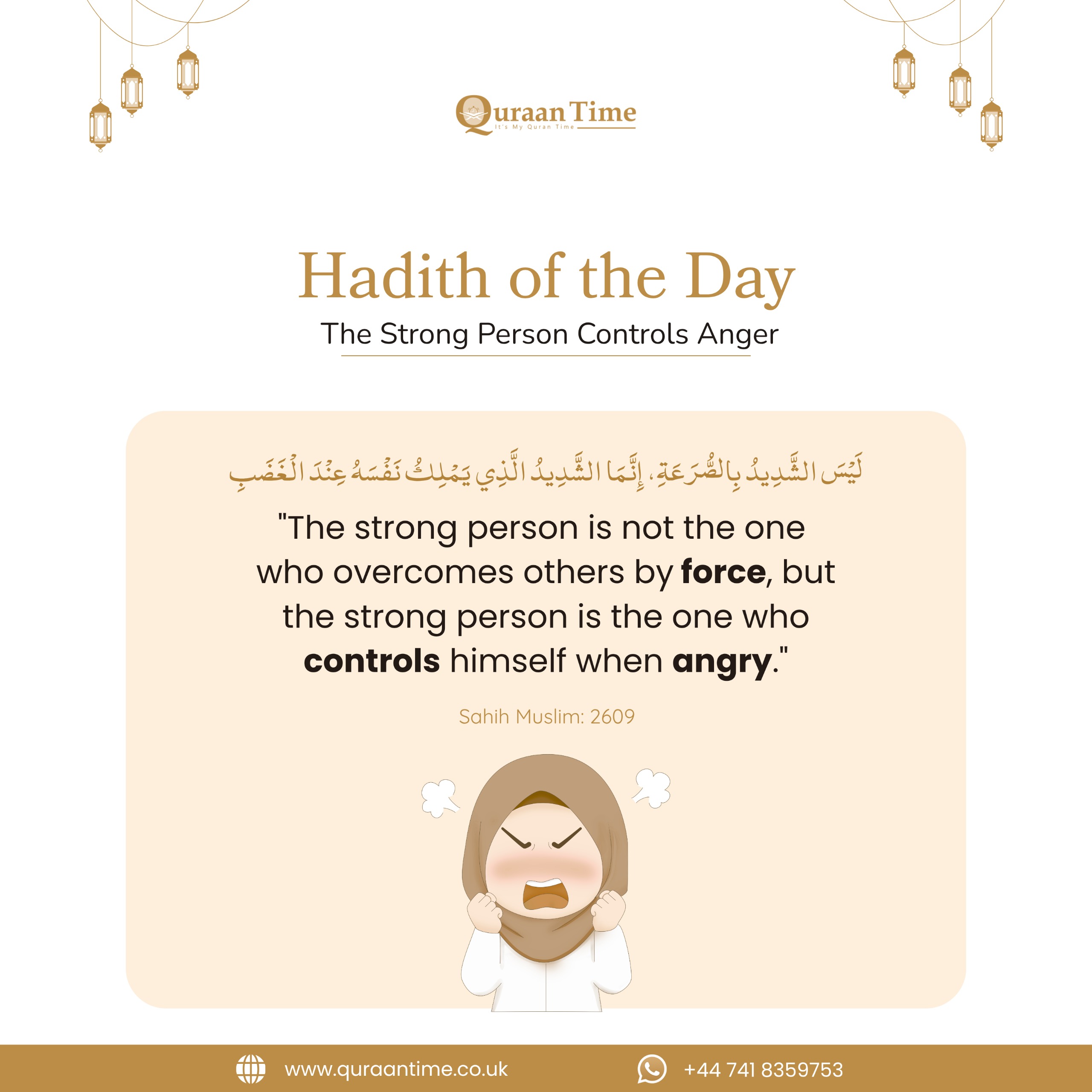
In a world that often glorifies dominance, aggression, and physical superiority, the Prophetic tradition redefines strength with a revolutionary lens. The Hadith of the Day — recorded in Sahih Muslim — redirects our attention from external victory to internal governance. The Arabic word ‘ṣarʿah’ (wrestling/overpowering) contrasts sharply with the inner dominion over one’s own nafs (self). The truly powerful person, as the Prophet Muhammad (peace be upon him) taught, is not the one who pins an opponent to the ground, but the one who pins down his own anger at the very moment it surges.
This teaching is profoundly relevant in our time. From road rage to online arguments, from workplace tensions to family disputes, the ability to pause, breathe, and respond with dignity is a hallmark of spiritual maturity. The Prophet’s words are not a denial of emotion but a channeling of it toward justice and mercy. When anger arises, the strong person remembers Allah, changes his posture, seeks refuge from Shayṭān, and if standing, sits down; if sitting, lies down — as other narrations advise. These physical and spiritual actions are anchors that prevent the storm of anger from capsizing the ship of one’s character.
Psychological research confirms that emotional regulation is a cornerstone of resilience, healthy relationships, and even physical well-being. The Hadith anticipates modern cognitive-behavioural approaches by emphasizing metacognition — the awareness of one’s emotional state — and the choice of response over reaction. It dismantles the toxic notion that showing restraint is a sign of weakness. On the contrary, restraint is the ultimate display of power because it requires mastery over the most impulsive part of the human psyche.
Furthermore, this Hadith fosters a culture of forgiveness and forbearance. It teaches that true strength is not measured by how many people you defeat, but by how many conflicts you de-escalate, how many harsh words you swallow, and how many times you choose silence over sarcasm. This is the path of the Prophets and the righteous.
Teacher’s perspective: Use storytelling and role-play. Narrate situations where a character chooses calmness and gains respect. Emphasise that anger is normal, but we have tools — like deep breaths, walking away, or saying “A‘ūdhu billāh” — to handle it. The goal is self-control, not suppression. Let children know that Allah loves the one who controls his anger even though he could retaliate.
Parent’s insight: Pause and step back. Use the ‘time-out’ technique yourself. Make wudū (ablution) — water cools the heat of anger. Then speak in a low tone, and if needed, delay the conversation. Model the Hadith by saying, “I am feeling angry, so I will take a moment.” Children learn more from what we do than what we say. This transforms discipline into a lesson in emotional intelligence.
Teacher & parent dialogue: Not at all. The Prophet (peace be upon him) expressed displeasure when limits were transgressed, but always with justice and without losing his composure. The Hadith encourages measured, constructive expression. We can say, “I am upset because…” without shouting or insulting. This preserves dignity and opens space for resolution. True strength is in assertive communication, not aggressive confrontation.
Educator’s reply: Make it a weekly ‘character challenge’. Discuss real-life scenarios, have students share experiences, and create an ‘anger management corner’ with calming strategies. Also, link it to Islamic values like forbearance (ḥilm) and mercy (raḥmah). When students see that self-control is valued as much as academic success, they internalise a balanced view of strength.
Each time you resist anger for the sake of Allah, you gain a victory that no trophy can match. The strong person is not the one who defeats others, but the one who defeats his own ego.