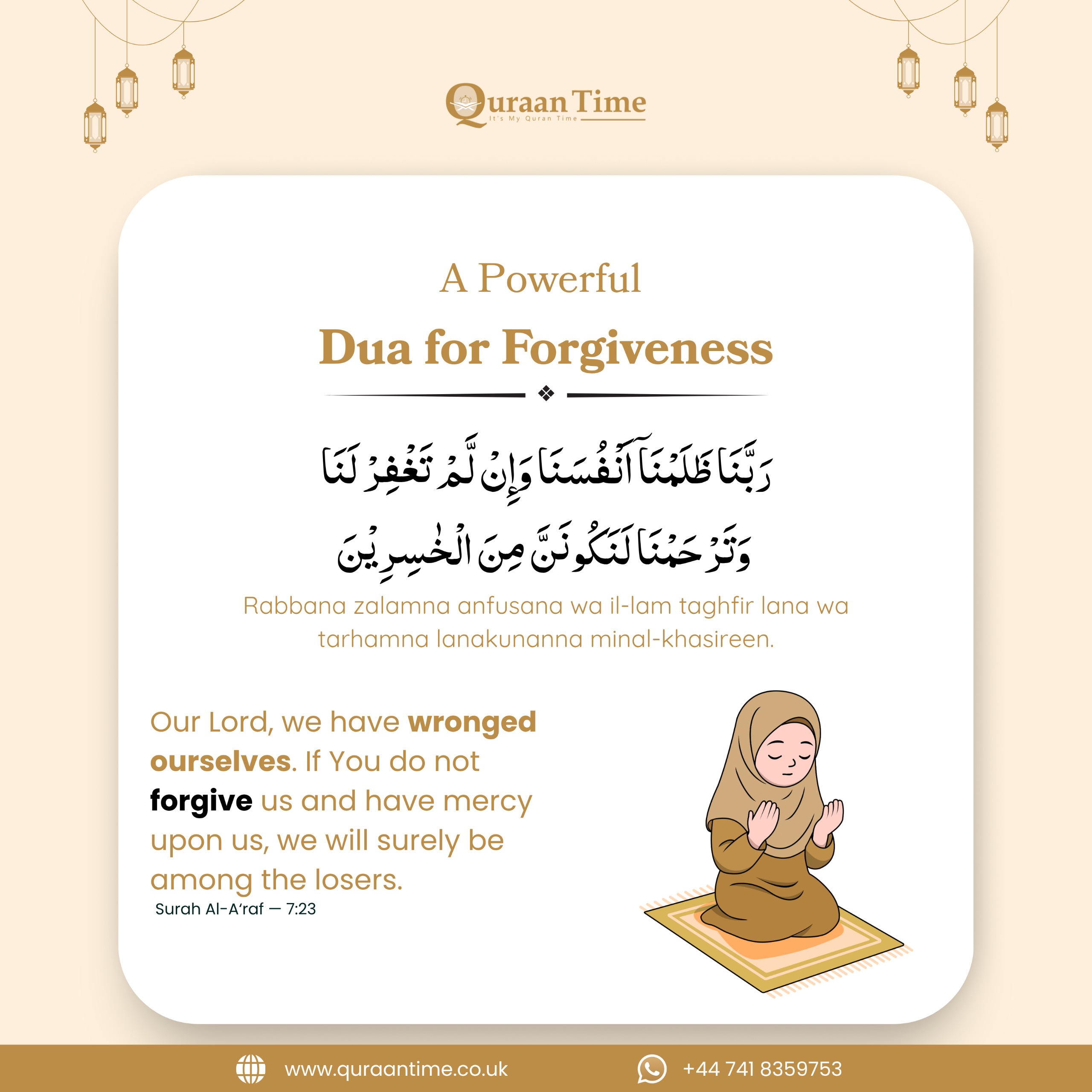
رَبَّنَا ظَلَمْنَاۤ اَنْفُسَنَا وَإِنْ لَّمْ تَغْفِرْ لَنَا
وَتَرْحَمْنَا لَنَكُونَنَّ مِنَ الْخٰسِرِيْنَ
Rabbana zalamna anfusana wa il-lam taghfir lana wa tarhamna lanakunanna minal-khasireen.
“Our Lord, we have wronged ourselves. If You do not forgive us and have mercy upon us, we will surely be among the losers.”
— Surah Al-A’raf (7:23)
This profound dua for forgiveness was uttered by Prophet Adam (peace be upon him) and his wife after they had erred in Paradise. It is not merely a plea for pardon, but a complete admission of human vulnerability, a recognition that without divine mercy, we are utterly lost. In just a few words, it encapsulates the essence of tawbah (repentance), humility, and absolute dependence on Allah.
● Why is this dua so powerful? It combines acknowledgment of sin, immediate return to Allah, and a clear statement of consequence — “we will be among the losers” — which stirs the heart to sincere desperation and hope.
The linguistic beauty of Rabbana zalamna anfusana carries a weight that every believer can feel. “Zalamna” (wronged) is not a passive mistake; it is an active injustice we commit against our own souls through disobedience. And yet, the dua rushes to Allah’s mercy before the sentence is complete — “wa il-lam taghfir lana” (and if You do not forgive us). This structure teaches us that forgiveness is never guaranteed by our deeds, but it is always within reach of Allah’s infinite compassion.
For educators, this dua offers a framework to teach children about accountability and divine love. It shows that even prophets made mistakes, yet they turned back to Allah with humility. It normalizes repentance as a daily practice, not a shameful act. Teachers can use this verse to build a classroom culture where mistakes are opportunities for growth, and seeking forgiveness is a sign of strength, not weakness.
Q. How can I use this dua to teach my child about repentance?
+
Teacher Start by explaining the story of Adam (peace be upon him) in a gentle way. Emphasize that Allah taught Adam these words — so repentance is a gift from Allah. Let the child repeat the dua with meaning, and encourage them to say it whenever they feel they’ve made a mistake, big or small.
Parent That is beautiful. But my child is very young, does he need to understand every word?
Teacher Not at all. At a young age, the sound and the feeling matter more. You can simplify: “We ask Allah to forgive us and be kind to us.” As they grow, layer the depth. The key is to make it a loving habit, not a fearful ritual.
Q. What if my child feels ashamed to ask for forgiveness repeatedly?
+
Parent Sometimes my son says, “I already asked Allah, but I did the same thing again.” He feels like a hypocrite.
Teacher This is a golden teaching moment. Remind him that the Prophet (peace be upon him) said: “The one who repents from sin is like one who has no sin.” Also, this very dua — “we have wronged ourselves” — is in the present tense, meaning we are always in need. Allah loves those who return to Him again and again. It is not hypocrisy; it is humanity.
Q. How can I integrate this dua into our daily routine?
+
Parent Between school, homework, and activities, we barely have time for structured duas.
Teacher Make it micro-habit. After every argument or moment of frustration, pause and recite it together. Or keep a small card in the car. You can also recite it after each prayer as a family. Consistency over perfection — even one sincere recitation a day plants the seed.
Parent So it’s more about the connection than the frequency?
Teacher Exactly. Quality of presence matters more than quantity. When you recite it with focus, the child learns that dua is a conversation with Allah, not just words.
Q. Is there a specific time to recite this dua?
+
Teacher While there is no restriction, the last third of the night, after obligatory prayers, and at times of distress are highly recommended. However, this dua is universal — you can say it anytime you feel the weight of your sins or the need for Allah’s mercy.
Parent And what about in the classroom setting?
Teacher Yes! Before an exam, after a lesson about morality, or even as a collective closing activity. It reinforces that we are all learners, including the teacher.
Q. How do I explain “losers” in the dua to a child without scaring them?
+
Parent My daughter asked, “Will I be a loser if I make a mistake?”
Teacher Clarify that the “losers” are those who do not seek Allah’s forgiveness, not those who make mistakes. We all err, but the real loss is to turn away from Allah’s mercy. This dua is the very remedy that saves us from being among the losers. So every time we say it, we are winners.
“The dua of Adam is a masterclass in humility: it admits fault, begs for pardon, and clings to hope — all in one breath. Teach it, live it, and let it transform your heart.”