Understanding the Depth
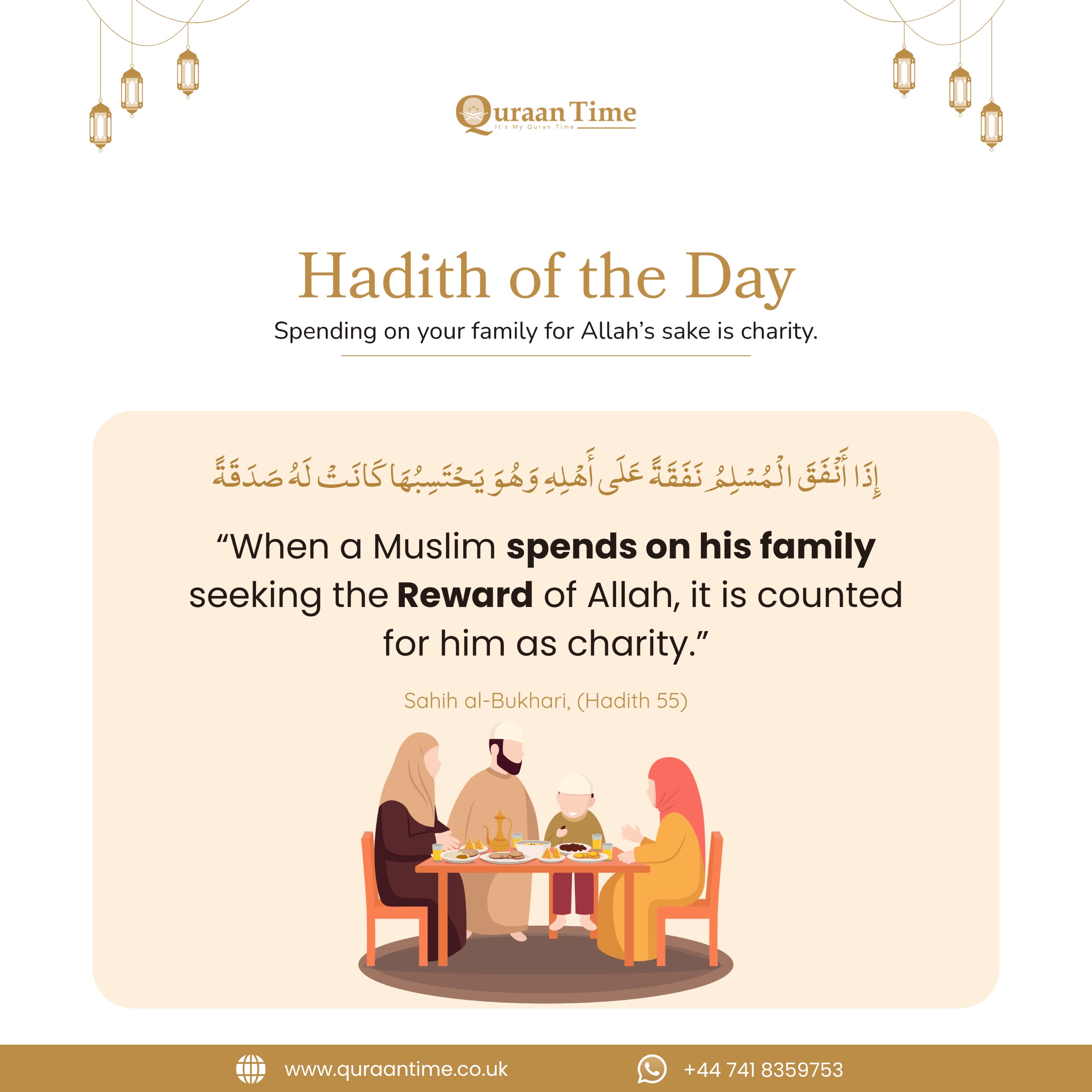
This profound hadith from Sahih al-Bukhari reshapes how we view daily family expenses.
It transforms mundane spending into an act of worship — every meal provided, every school fee paid,
every clothing item bought for the sake of Allah elevates the believer’s spiritual ledger.
The Prophet (peace be upon him) taught that even the morsel you place in your spouse’s mouth is charity.
This is not merely about financial support; it is about intention, love, and the recognition that
family is the first circle of responsibility.
The Arabic word “nafaqah” (spending) here encompasses all forms of maintenance: food, shelter, education,
health, and emotional care. When anchored in ikhlas (sincerity), the reward multiplies.
Unlike public charity (sadaqah) which is often visible, family spending is private yet immensely rewarding.
The hadith encourages us to see our homes as fields of harvest — where every dirham spent with the right
intention yields eternal fruits.
Teacher & Parent Q&A
Q
Parent: “Is spending on my family really equal to charity, even if it’s just basic needs?”
Teacher
Absolutely. The Prophet (PBUH) clearly stated that whatever you spend on your family with
the intention of seeking Allah’s pleasure is recorded as sadaqah.
This includes food, rent, school supplies, and even a warm blanket. The key is the intention
(niyyah). When you renew your intention daily — “I am providing for my family to fulfill Allah’s
command” — the ordinary becomes extraordinary.
Q
Parent: “What about adult children or extended family — does this hadith include them?”
Teacher
The primary obligation is towards those you are legally and Islamically responsible for —
spouse, children, and parents in need. But scholars mention that spending on any relative
with the intention of upholding ties of kinship also carries great reward. However,
the hadith specifically emphasizes the family unit because it is the foundation of society.
The closer the relation, the greater the reward when spent with sincerity.
Q
Parent: “How can I maintain this intention when finances are tight and I feel stressed?”
Teacher
This is a beautiful test of faith. Remember that the reward is based on the effort and intention,
not the amount. The Prophet said: “Even a small piece of date given in charity is accepted.”
When you are stressed, make du’a and remind yourself that Allah is the Provider.
Your struggle to provide is itself a form of worship. Also, involve your family in du’a
and gratitude — this turns the home into a place of spiritual resilience.
Beyond the Hadith
Imam al-Bukhari placed this hadith in the book of “Al-Adab” (good manners) and also in “Az-Zakat”
(charity), showing its dual nature. It bridges worship and ethics.
When a father works tirelessly and spends on his children, he is not just a breadwinner;
he is a worshipper. A mother who manages the household budget with care and feeds her children
nutritious meals is engaging in an act of ‘ibadah. The hadith also teaches us
to be grateful for the ability to give — and to ask Allah to accept it.
Modern life often separates the sacred from the secular, but this hadith reunites them.
Your 9-to-5 job, your grocery shopping, your monthly bills — all can become vehicles for
divine reward. The key is to connect your heart to Allah in every transaction.
Even when you pay for your child’s extracurricular class, you are investing in their future
and earning Allah’s pleasure simultaneously.
S
Spiritual Spending Checklist
• Intention: “I spend for Allah’s reward.”
• Gratitude: Thank Allah for the means to give.
• Quality: Spend within your means, but with excellence.
• Dua: Ask Allah to bless your family and your wealth.
The beauty of this hadith is that it empowers every Muslim — regardless of their financial status —
to earn ongoing charity. The poor who spends on his child with love receives the same reward as the rich
who gives a large donation. It also removes any guilt from spending on oneself and one’s family;
rather, it elevates it to an act of devotion. Let this Hadith of the Day change how you view your
wallet, your home, and your family.
May Allah make our spending a means of purification, our families a source of sadaqah jariyah,
and our homes gardens of paradise. Ameen.