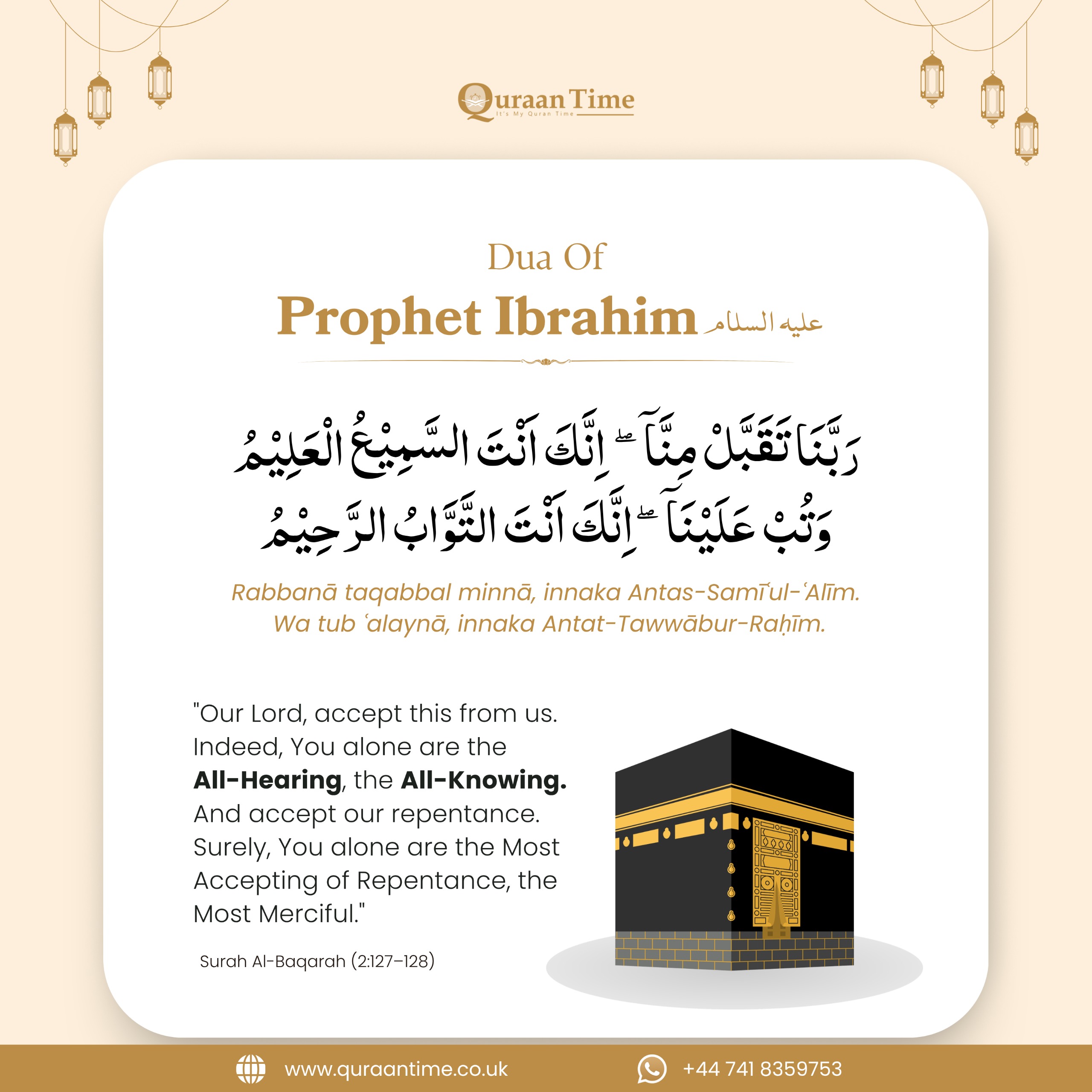
رَبَّنَا تَقَبَّلْ مِنَّا ۖ إِنَّكَ أَنْتَ السَّمِيعُ الْعَلِيمُ
وَتُبْ عَلَيْنَا ۖ إِنَّكَ أَنْتَ التَّوَّابُ الرَّحِيمُ
Rabbanā taqabbal minnā, innaka Antas-Samīʿul-ʿAlīm.
Wa tub ʿalaynā, innaka Antat-Tawwābur-Raḥīm.
The Dua of Prophet Ibrahim (A.S.) is a profound supplication that encapsulates complete submission, humility, and reliance on Allah. It was uttered during the construction of the Kaaba, a moment of immense spiritual significance. This dua is not merely a historical invocation; it is a timeless lesson in sincerity and the art of turning to Allah in all our affairs.
When Prophet Ibrahim and his son Ismail (A.S.) were raising the foundations of the House of Allah, they called upon their Lord with this beautiful prayer. The dua reflects two core themes: acceptance of deeds and repentance for shortcomings. The words “taqabbal minnā” (accept from us) reveal the Prophets’ deep consciousness that even their greatest acts of worship needed Allah’s gracious acceptance. It teaches us that no deed is worthy of pride; rather, we should always seek Allah’s approval.
﴾ إِنَّكَ أَنْتَ السَّمِيعُ الْعَلِيمُ ﴿
Allah is the All-Hearing, He hears every whisper of the heart, and All-Knowing, He knows our intentions, struggles, and hopes. This attribute brings comfort to the believer, knowing that our duas are never lost.
The second part of the dua, “Wa tub ‘alaynā” (and accept our repentance), is a plea for divine forgiveness and purification. Prophet Ibrahim, despite his exalted status, sought repentance, highlighting that every soul is in need of Allah’s mercy. The names At-Tawwāb (the Acceptor of Repentance) and Ar-Raḥīm (the Most Merciful) reassure us that Allah’s mercy encompasses all who turn back to Him.
This dua is a comprehensive guide for our daily lives. It reminds us to begin every action with the intention of pleasing Allah, to acknowledge our dependence on Him, and to constantly seek His forgiveness. Whether we are building a physical structure or nurturing our character, the essence of Ibrahim’s dua should permeate our efforts.
How can we teach the meaning of this dua to children?
Teacher: Explain it through stories of Ibrahim (A.S.) building the Kaaba. Use simple language: “We ask Allah to accept our good deeds and forgive our mistakes.” Relate it to their daily acts like helping others or praying.
Parent: We can recite it together after prayers and discuss what “acceptance” means in our lives.
Why did Prophet Ibrahim ask for acceptance if he was already a Prophet?
Teacher: It shows his humility and teaches us that even the best among us rely on Allah’s grace. It’s a reminder that no one is self-sufficient.
Parent: This encourages our children to be humble and not arrogant about their achievements.
How does the dua connect to our daily repentance?
Teacher: The dua combines action (building the Kaaba) with supplication. It teaches that deeds and dua go hand in hand. We should repent sincerely after every act, knowing that Allah is At-Tawwāb.
Parent: We can set a routine of reciting this dua when we feel we’ve made a mistake, instilling a habit of turning back to Allah.
What is the significance of the names “Samīʿ” and “ʿAlīm” in this context?
Teacher: They affirm that Allah hears our innermost pleas and knows our true intentions. This brings peace to the heart; we don’t need to vocalize everything—He knows.
Parent: We remind our children that even when they feel shy to ask, Allah understands their feelings.
Reflection from the Qur’an
The dua of Ibrahim (A.S.) is not just a request—it is a declaration of Tawḥīd (Oneness of Allah) and a recognition of human weakness. When we recite it, we align ourselves with the legacy of the Prophets. It is a powerful tool for spiritual growth, especially during times of difficulty or when seeking Allah’s guidance for our families.
In our modern context, this dua encourages us to transform our homes and communities into places of remembrance. Parents and teachers can use it as a foundational prayer for children, embedding the values of sincerity, repentance, and hope in their hearts. The Prophet Ibrahim’s legacy lives on through this concise yet comprehensive supplication.