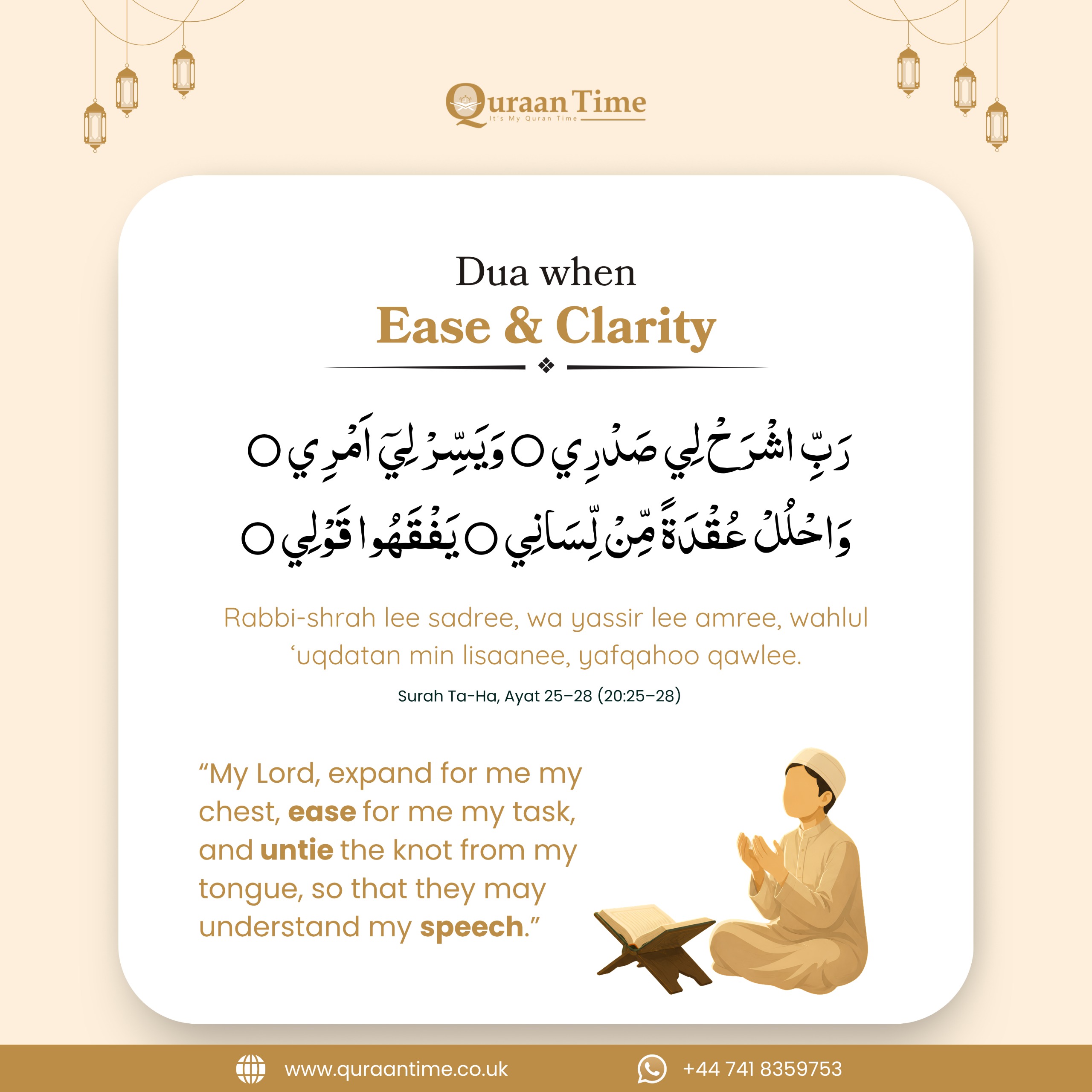
Rabbi-shrah lee sadree, wa yassir lee amree, wahlu ‘uqdatan min lisaanee, yafqahoo qawlee.
Surah Ta-Ha, Ayat 25–28 (20:25–28)
“My Lord, expand for me my chest, ease for me my task, and untie the knot from my tongue, so that they may understand my speech.”
Understanding the Dua: A Deep Dive
This profound supplication, taught to Prophet Musa (peace be upon him) before his encounter with Pharaoh, encapsulates the human need for divine support in moments of immense responsibility. The dua for ease and clarity is not merely a request for fluency; it is a spiritual, psychological, and social petition that touches every aspect of our being.
The first phrase, “Rabbi-shrah lee sadree” (expand my chest), points to inner peace, courage, and the removal of anxiety. A constricted chest—metaphorically—indicates fear, hesitation, or grief. By asking Allah to “expand” it, we seek the capacity to bear challenges with grace and resilience. This is the foundation of clarity: a tranquil heart breeds a lucid mind.
Second, “wa yassir lee amree” (ease my task). Here, we acknowledge that human effort alone is insufficient. True facilitation comes from the Creator. Whether it is a difficult conversation, a complex project, or a personal milestone, this part of the dua aligns our will with divine assistance, turning obstacles into manageable steps.
Third, “wahlu ‘uqdatan min lisaanee” (untie the knot from my tongue). This is a direct plea for eloquence and clarity of speech. In Musa’s case, he had a speech impediment, but the request extends to anyone who stumbles over words, fears public speaking, or struggles to convey their heart. The “knot” can also represent mental blocks, confusion, or the inability to articulate complex ideas.
Finally, “yafqahoo qawlee” (so that they may understand my speech). The ultimate goal is not just self-expression but effective communication. When we are understood, our message resonates, relationships deepen, and our purpose is fulfilled. This dua bridges the gap between intention and impact.
Practical Benefits in Daily Life
Teachers, parents, professionals, and students alike can turn to this dua before exams, meetings, teaching sessions, or even difficult family discussions. It instills a sense of reliance on Allah while encouraging proactive effort. The combination of spiritual preparation and practical action creates a powerful synergy.
Many scholars recommend reciting this dua in the morning, before any major task, or during moments of overwhelm. It is a reminder that clarity is not just about speaking, but about listening, understanding, and being understood with compassion.
Questions & Answers: Teachers and Parents Reflect
How can this dua help a teacher before a challenging class?+
A teacher faces the immense task of conveying knowledge to diverse minds. Reciting “Rabbi-shrah…” opens the heart to patience, eases the delivery of complex material, and removes the “knot” of nervousness. It also fosters a receptive atmosphere, so students grasp the lesson with clarity. Many educators share that this dua transforms their classroom energy.
Can parents use this dua for better communication with their children?+
Absolutely. Parenting involves constant dialogue—guiding, correcting, and encouraging. This dua softens the parent's tone and clarifies their intentions. When recited with sincerity, it helps parents choose words that are firm yet kind, and children are more likely to listen and understand, strengthening the family bond.
Does this dua only help with speech, or does it have broader effects?+
While the immediate context is speech, the dua encompasses emotional and mental clarity. “Expanding the chest” alleviates stress, “easing the affair” simplifies complex situations, and “loosening the tongue” improves all forms of expression. It is holistic—impacting confidence, decision-making, and interpersonal relationships.
Is there a specific time or posture recommended for this dua?+
While it can be recited anytime, many find it most effective during the last third of the night, between Sunnah and Fard prayers, or before undertaking a significant task. The key is presence of heart and conviction. Raising hands in supplication is a sunnah, but the essence lies in the internal connection with Allah.
Reflection: This dua is a timeless gift from the Qur’an. It reminds us that clarity is not just a skill, but a blessing. When we feel overwhelmed, tongue-tied, or lost, turning to Allah with these words opens doors we never imagined. May we all be granted ease, understanding, and eloquence.
✧ Recite with intention, reflect with the heart, and act with confidence.