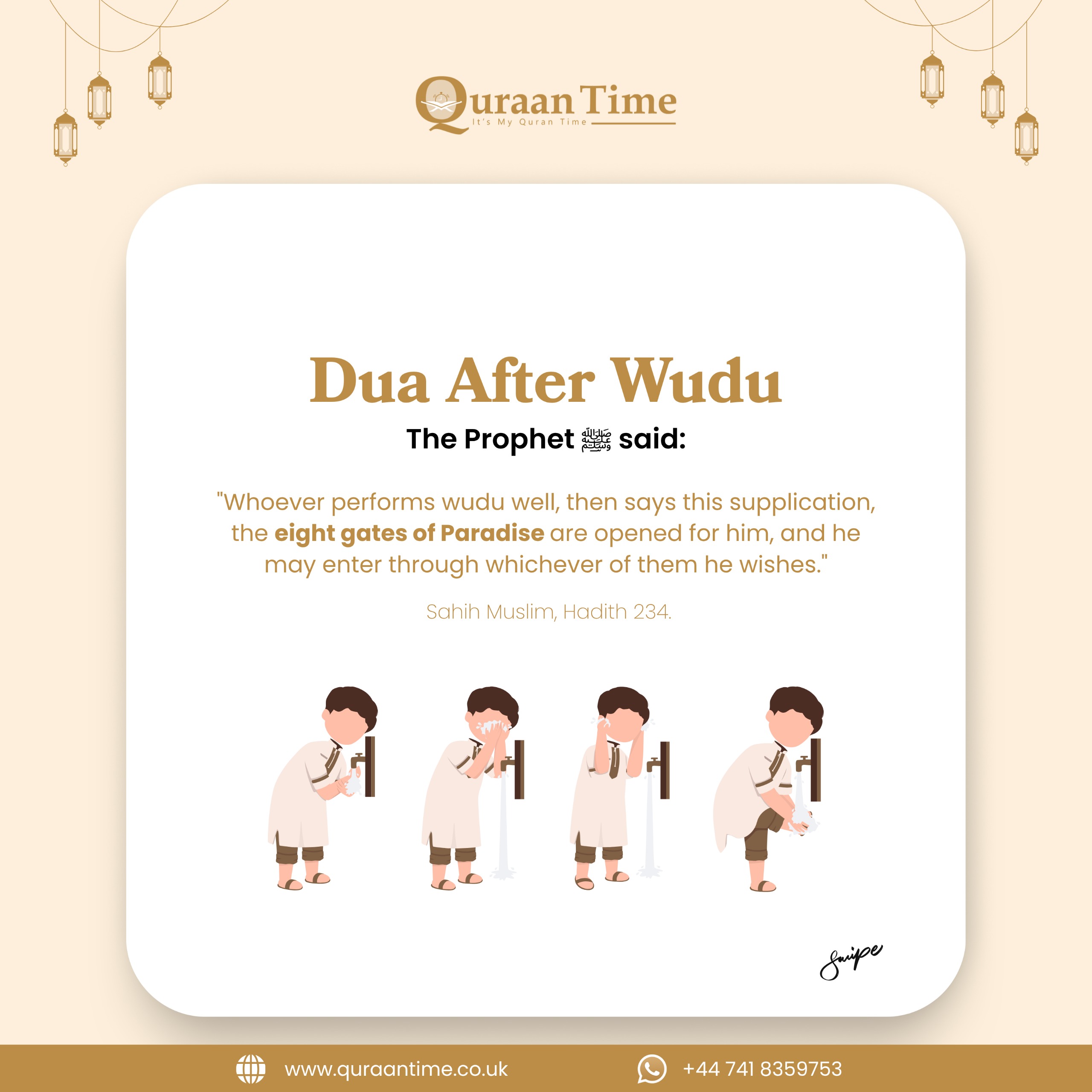
"Whoever performs wudu well, then says this supplication,
the eight gates of Paradise are opened for him, and he may enter through whichever of them he wishes."
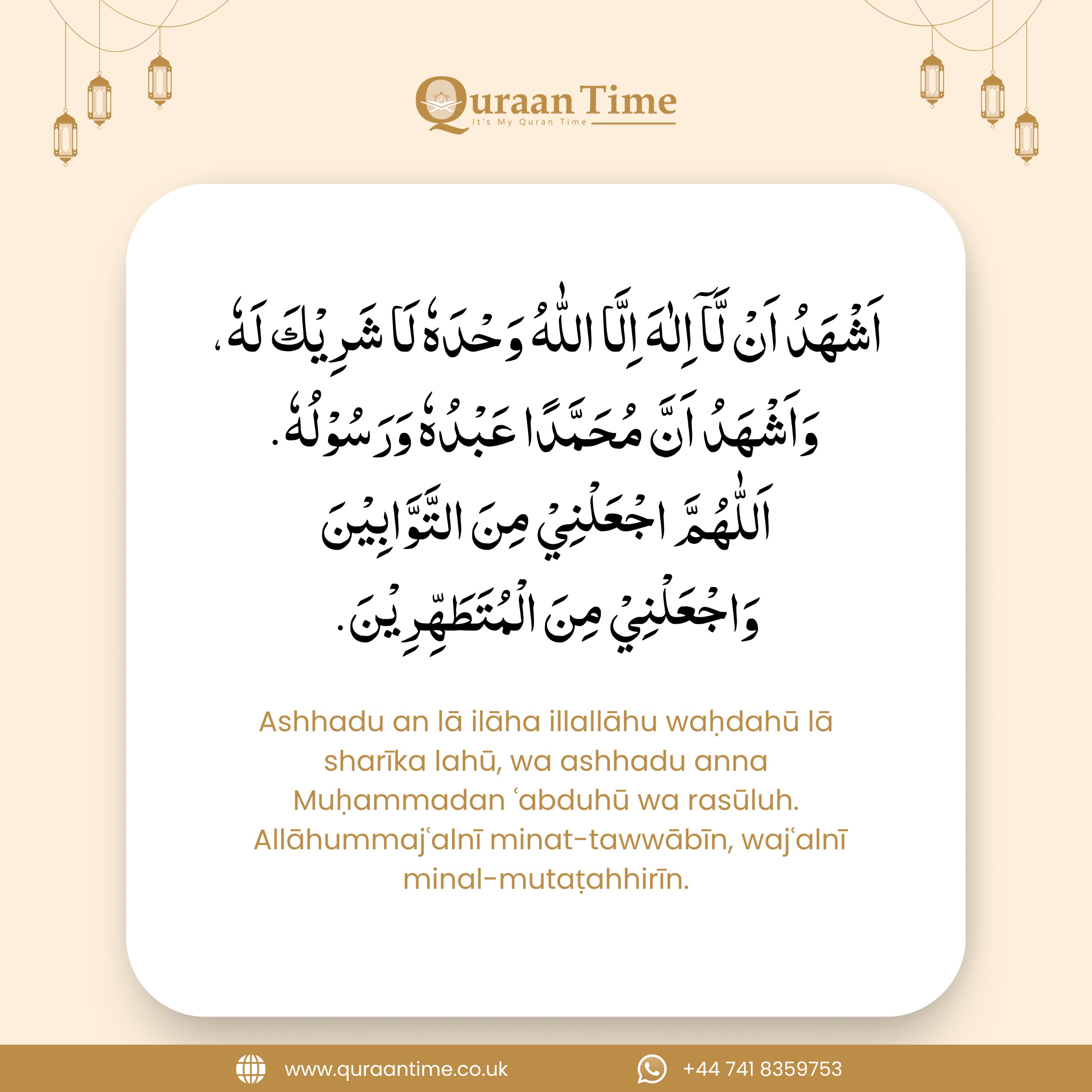
Transliteration: Ashhaadu an lā ilāha illallāhu wahdaḥū lā sharīka laḥū,
wa ashhaḍu anna Muḥammadan ‘abduḥū wa rasūluh.
Allāhummaj‘alnī minat-tawwābīn, waj‘alnī minal-mutaṭahhirīn.
The Prophetic Promise:
The Messenger of Allah (peace be upon him) said:
“Whoever performs ablution (wudu) perfectly, then says this dua,
the eight doors of Jannah are opened for him, and he may enter from any gate he chooses.”
— Sahih Muslim, Book of Purification, Hadith 234
The Depth of This Supplication
This powerful dua after wudu is not merely a ritual utterance; it is a spiritual key to the highest ranks of Paradise. The words “La ilaha illallah” reaffirm the oneness of Allah, while the testimony of Muhammad’s servitude and prophethood completes the foundation of faith. The dua then humbly asks Allah to make us among at-tawwabeen (those who repent often) and al-mutatahhireen (those who purify themselves). These two qualities—frequent repentance and outward/inward purification—are beloved to Allah and lead to endless mercy.
In a world where we often rush through our wudu, pausing to recite this dua with presence transforms a physical act of washing into a spiritual ascent. The eight gates of Paradise symbolize the comprehensive reward: no matter which gate you approach, it swings open. Some scholars mention that the eight gates correspond to the eight limbs washed in wudu, or the eight categories of righteous deeds. But the core message is divine generosity: a small act, when perfected with intention and this dua, brings immense reward.
It is also recommended to recite this dua immediately after completing wudu, while the water is still fresh on the limbs, as a sign of gratitude and remembrance. The Prophet (peace be upon him) emphasized excellence in wudu — washing each part thoroughly, avoiding waste, and remembering Allah at every step. When you combine excellence with this dua, the spiritual effect multiplies.
Teachers & Parents Ask
How can I help my children memorize this dua with understanding?
Break the dua into three parts. First, the shahada (La ilaha illallah…). Second, the testimony for Muhammad. Third, the two requests (make me among the repentant and the purified). Use visual charts, repeat it after each wudu, and explain the meaning simply. For example, “At-tawwabeen” means those who always say sorry to Allah, and “mutatahhireen” means those who keep clean inside and out. Reward them with small incentives and make it a family routine.
Is this dua only for after wudu, or can it be recited at other times?
While the specific reward of the eight gates is tied to reciting it after completing wudu, the words themselves are general remembrances (dhikr) and can be recited at any time. However, to gain the full virtue mentioned in the hadith, it should be recited immediately after wudu, with presence of heart and conviction. Some scholars also recommend it after washing each limb, but the strongest practice is after finishing the entire wudu.
What if I forget to say it right after wudu? Can I say it later?
If you forget, you can still recite it as long as your wudu remains valid (i.e., you haven’t broken it). The best time is right after, but if you remember shortly after, you may recite it and Insha’Allah the reward is still hoped for. However, to be safe, try to make it a fixed habit. Set a reminder or whisper it softly immediately after the final wash. The Prophet (peace be upon him) taught us to be consistent, and Allah sees your effort.
Does the dua have to be in Arabic, or can I say it in my language?
The authentic sunnah is to recite it in Arabic as it was taught. However, if you are learning, you may say it in your language to understand the meaning, but gradually strive to learn the Arabic. For the full reward, it is recommended to say the exact words in Arabic, even if you recite slowly. Allah knows your intention, and He rewards you for your effort. You can also say the Arabic and then reflect on its meaning in your heart.
0 times recited today
(click to increase your count)
Pro-Tip: Combine this dua with “Rabbana atina fid-dunya hasanah…” after wudu for extra blessings.