
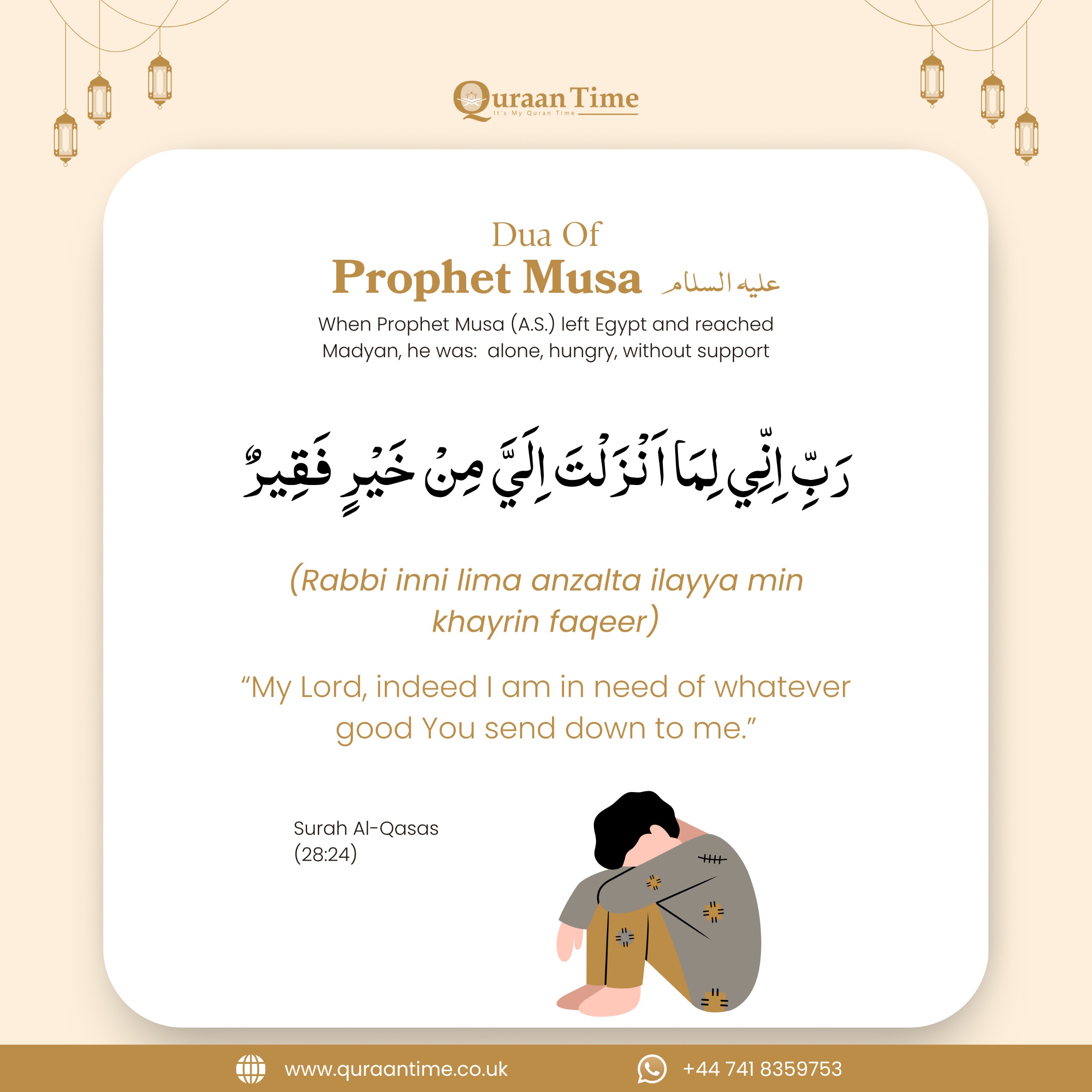

رَبِّ إِنِّي لِمَا أَنْزَلْتَ إِلَيَّ مِنْ خَيْرٍ فَقِيرٌ
Rabbi inni lima anzalta ilayya min khayrin faqeer
“My Lord, indeed I am in need of whatever good You send down to me.”
Surah Al-Qasas (28:24) — After drawing water for the flock
The context of desperation & divine encounter
Prophet Musa (AS) had just fled from Egypt after the news of the slain Egyptian spread. He was alone, traversing the barren route to Madyan, exhausted, without any provisions or companion. The Quran depicts a man who possessed no material support — no money, no reputation, not even a place to rest. When he reached the well of Madyan, he saw shepherds watering their flocks while two women waited aside. Out of chivalry, he watered their animals, then retreated under a shaded tree. There, hungry and weary, he raised his hands and whispered the most profound dua of need: “Rabbi inni lima anzalta ilayya min khayrin faqeer.” Within moments, one of the women returned, inviting him to her father’s home, then employment, then marriage and safety. This supplication became a timeless lesson: admitting one's complete dependence on Allah is the key to unexpected blessings.
Prophet Musa (AS) had just fled from Egypt after the news of the slain Egyptian spread. He was alone, traversing the barren route to Madyan, exhausted, without any provisions or companion. The Quran depicts a man who possessed no material support — no money, no reputation, not even a place to rest. When he reached the well of Madyan, he saw shepherds watering their flocks while two women waited aside. Out of chivalry, he watered their animals, then retreated under a shaded tree. There, hungry and weary, he raised his hands and whispered the most profound dua of need: “Rabbi inni lima anzalta ilayya min khayrin faqeer.” Within moments, one of the women returned, inviting him to her father’s home, then employment, then marriage and safety. This supplication became a timeless lesson: admitting one's complete dependence on Allah is the key to unexpected blessings.
The Depth of 'Faqeer' – Beyond Material Poverty
Spiritual neediness
The Arabic word Faqeer does not merely signify lack of money; it expresses the soul's intrinsic poverty before Allah. Musa AS teaches us that every breath and favour is a gift.Tawakkul in action
Rather than panicking, Musa AS turned to Allah. This dua preludes a series of miracles: marriage, safety and prophethood. The prayer transforms vulnerability into divine proximity.🌿 Open-ended supplication
“Whatever good You send down” shows ultimate surrender – not demanding specific outcome but trusting Allah’s wisdom. It builds contentment and resilience. Timeless Lessons for Parents & Teachers
The Dua of Musa (AS) is a beacon for parents wishing to instil deep reliance on God in children. When a child feels anxious about exams, friendship, or loss, reciting this supplication reshapes their mindset: "I am in need of whatever good Allah sends" reduces desperation and expands gratitude. Parents can model this by reciting it during family hardships, demonstrating that asking Allah with neediness is nobility. Teachers in Islamic schools can integrate the story of Madyan into lessons: Musa was a stranger, yet he didn't complain, he prayed. This dua also teaches emotional intelligence — acknowledging one's limits and turning to the Creator. Additionally, it fosters humility in times of success and patience in scarcity.
Teachers & Parents Q&A — The Dua of Musa (AS) in Daily Life
Musa (AS) understood that Allah knows what is best. By asking for 'any good' he displayed complete reliance. This open request brought him marriage, family and a purpose. Parents can explain that sometimes we ask for specifics, but trusting Allah's choice brings greater barakah.
Teachers can use storytelling with props: describe being alone, tired, hungry, but instead of crying, he spoke to Allah. Role-play 'when you feel scared or lonely, say this dua.' Practical memorization with meaning. Also, ask children: what is one good thing you need today? Then recite Rabbi inni lima anzalta together.
While the Quran does not assign a fixed reward count, scholars mention that reciting this dua instills humility and opens doors to sustenance. It was the direct prayer of a noble Prophet accepted immediately by Allah. Reciting in times of distress helps one recognise Allah as the only provider and brings peace to the heart.
Absolutely. 'Whatever good' encompasses halal provision, knowledge, clarity and success. Before an exam, or job interview, recite this dua with conviction. It reorients intention: success is from Allah, and we are needy of His guidance. Parents can encourage teens to make it a morning/evening habit.
Anxiety often stems from feeling out of control. This dua transforms that feeling into spiritual action: “I am faqeer (needy) before you, O Allah.” It reminds us that worry does not help, but reliance on God does. Recite it deeply, take practical steps, and trust Allah’s plan — just as Musa (AS) was provided with shelter and a loving family.
Why Primary & Secondary Colors? #BC8D46 (golden earth) & #E7D2B6 (gentle linen) —
Inspired by the desert of Madyan, warmth of faith, and humility of Prophet Musa. The palette reflects spiritual richness and simplicity.
Detailed Analysis: The Moment after Dua
1. Immediate Response
Right after the dua, one of the two women (Saffura) came bashfully to invite him to her father Prophet Shu’ayb (AS). Allah sent help within minutes — a reminder that when we declare our need, doors open.2. From Stranger to Leader
Musa (AS) went on to work for ten years, gained a family, and eventually received prophethood. The dua became the seed of a prophetic journey — all because he admitted his need.3. Educational Takeaway
For Islamic schools, this dua is ideal for morning assembly or before exams. It teaches children that asking Allah is strength, not humiliation. Let them memorize it with the story of kindness and mercy.Practical implementation: Parents guide
Step 1: Narrate the full story of Musa (AS) reaching Madyan (Surah Al-Qasas). Step 2: Discuss the meaning of 'Faqeer' – complete neediness before Allah. Step 3: Practice the dua in Arabic & English during family supplication. Step 4: Encourage children to recite when they lose something, feel sad, or before a challenge. Step 5: Share stories of how Allah answered this prayer for pious people.