خَاتَمَ النَّبِيِّينَ
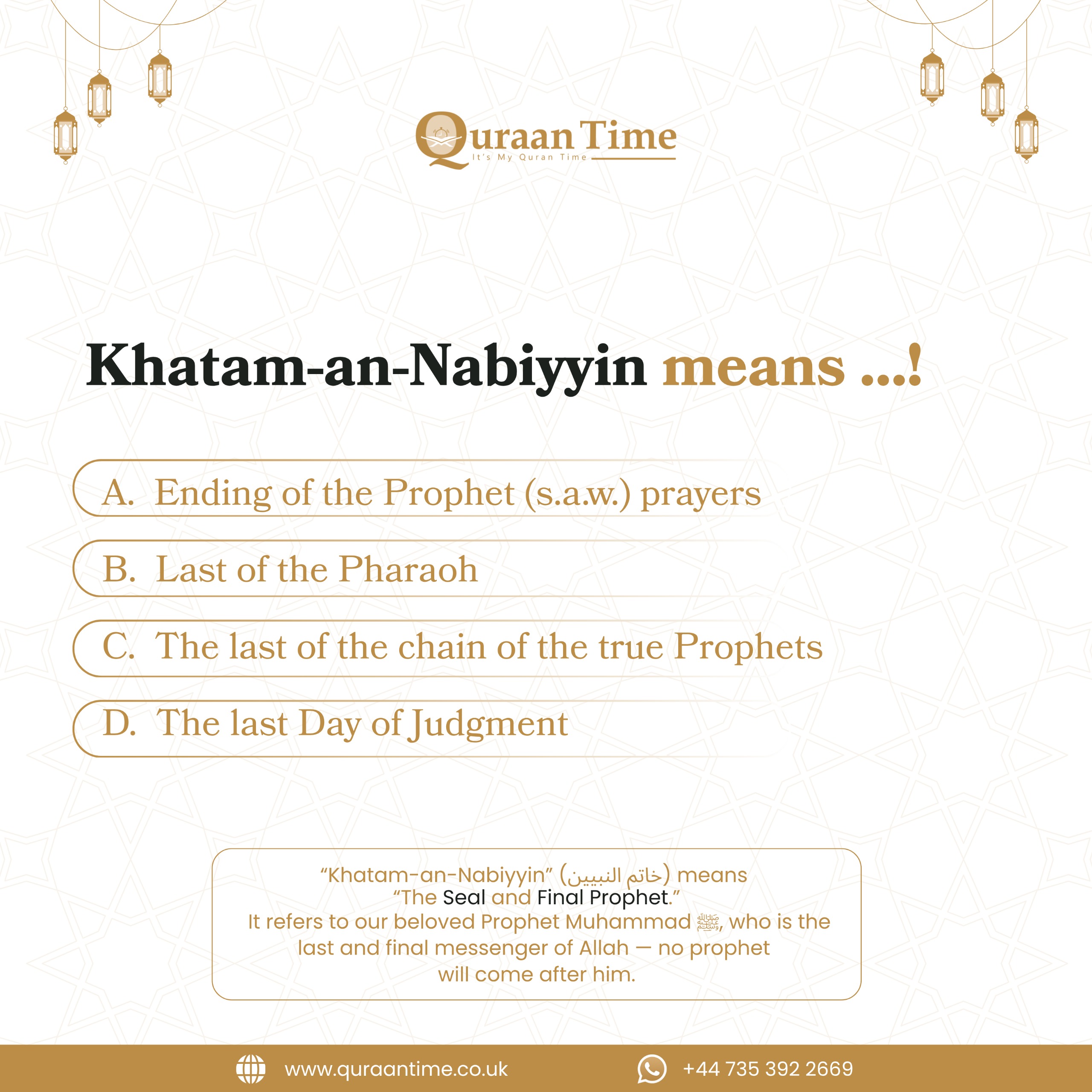
"Khatam-an-Nabiyyin" means "The Seal and Final Prophet"
It refers to our beloved Prophet Muhammad (peace be upon him), who is the last and final messenger of Allah — no prophet will come after him.
What does "Khatam-an-Nabiyyin" mean?
- A. Ending of the Prophet (s.a.w.) prayers
- B. Last of the Pharaoh
- C. The last of the chain of the true Prophets
- D. The last Day of Judgment
Quranic Foundation of Khatam-an-Nabiyyin
The term "Khatam-an-Nabiyyin" comes directly from the Holy Quran in Surah Al-Ahzab, where Allah declares the finality of Prophet Muhammad's prophethood. This concept is fundamental to Islamic belief and distinguishes Islam from other faiths.
"Muhammad is not the father of any of your men, but he is the Messenger of Allah and the last of the prophets. And Allah is ever, of all things, Knowing."
Surah Al-Ahzab (33:40)
Why This Concept Matters
FINALITY
Completion of Revelation
Signifies that divine revelation is complete with the Quran
PERFECTION
Perfect Guidance
Assures Muslims that Islam provides complete guidance for humanity
UNITY
Preservation of Faith
Protects Islamic teachings from alteration and distortion
CLARITY
Clear Distinction
Distinguishes authentic Islamic belief from innovations
Common Questions About Khatam-an-Nabiyyin
What is the difference between Nabi and Rasul?
A Nabi (Prophet) receives revelation but may not have a new scripture, while a Rasul (Messenger) brings a new divine law. Prophet Muhammad (peace be upon him) is both the final Nabi and Rasul, making him Khatam-an-Nabiyyin and the seal of all messengers.
Does this mean no religious guides can come after Prophet Muhammad?
While no new prophets will come, Muslims believe in the continuous appearance of religious scholars, reformers (Mujaddids), and saints (Awliya) who revive and explain Islamic teachings. However, they cannot bring new revelation or change Islamic law.
How should Muslims respond to claims of new prophets?
Muslims must firmly reject any claims of prophethood after Muhammad (peace be upon him). Such claims contradict clear Quranic verses and the consensus of Islamic scholars throughout history. The door to prophethood is permanently closed.
What about Jesus (Isa) returning before Day of Judgment?
When Jesus (peace be upon him) returns, he will not bring a new religion but will follow and implement the teachings of Quran and Sunnah. He returns as a follower of Prophet Muhammad, not as a new prophet with new revelation.
Essential Beliefs About Finality of Prophethood
- Prophet Muhammad (peace be upon him) is the final prophet for all humanity
- The Quran is the last and complete divine revelation
- Islamic teachings are perfect and require no addition
- No new prophet can come before Day of Judgment
- All previous prophets testified to Muhammad's coming
- Following Prophet Muhammad means following all prophets
Common Misconceptions Clarified
Misconception: "Seal" means best prophet, not necessarily last
Truth: Both meanings are correct - he is the best and the final prophet
Misconception: Minor prophets can still come
Truth: No prophets of any kind can come after Prophet Muhammad
Misconception: This is just an Islamic interpretation
Truth: This is explicit Quranic text with scholarly consensus
Deepen Your Understanding of Islamic Beliefs
Learn more about the fundamentals of Islamic faith and Prophethood
Explore Islamic Studies