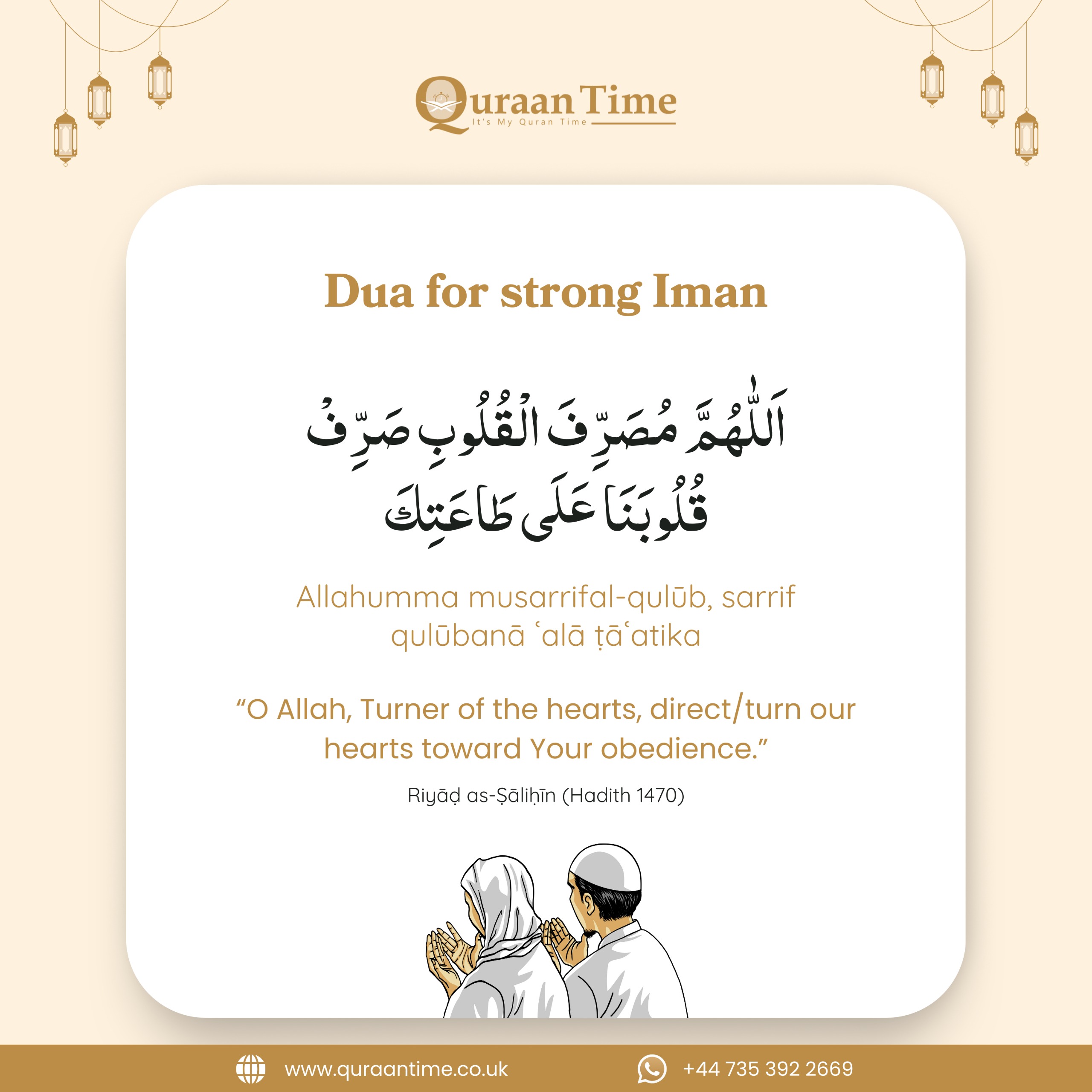
In the journey of faith, believers often seek ways to strengthen their Iman (faith) and maintain spiritual resilience. Among the most profound supplications taught by the Prophet Muhammad (peace be upon him) is the Dua for Strong Iman—a heartfelt plea for Allah to turn our hearts toward obedience and steadfastness. This comprehensive guide explores this powerful dua, its meaning, significance, and practical applications for daily spiritual life.
اَللّٰهُمَّ مُصَرِّفَ الْقُلُوبِ صَرِّفْ قُلُوبَنَا عَلَى طَاعَتِكَ
Allahumma musarrifal-qulub, sarrif qulubanā ‘alā ṭā‘atika
Translation: "O Allah, Turner of the hearts, direct/turn our hearts toward Your obedience."
Source: Riḍwān aṣ-Ṣāliḥīn — Hadith 1470
The Spiritual Significance of This Dua
This dua represents a deep understanding of the human heart's nature and our dependence on Allah for spiritual guidance. Unlike physical strength that comes from exercise and nutrition, the strength of Iman comes directly from Allah's mercy and guidance. By reciting this supplication, we acknowledge several fundamental truths:
1. Divine Control Over Hearts
We recognize that Allah alone has ultimate control over the orientation and condition of human hearts. No effort succeeds without His permission and guidance.
2. Proactive Spiritual Maintenance
Rather than waiting for spiritual weakness to set in, this dua represents proactive maintenance of faith, asking Allah to keep our hearts inclined toward obedience before deviation occurs.
3. Collective Supplication
The use of "our hearts" (qulubana) instead of "my heart" teaches us the importance of collective spiritual care and concern for the entire Muslim community's faith.
4. Specificity in Request
We don't merely ask for general goodness but specifically for our hearts to be turned toward "Your obedience" (ṭā‘atika), which encompasses all forms of worship and righteous deeds.
Practical Guidance: Questions from Parents and Teachers
Q: How can I explain the concept of Iman strength to my children using this dua?
A: Begin by comparing Iman to a plant that needs regular watering and sunlight. Explain that just as plants need care to grow strong, our faith needs spiritual nourishment. This dua is like asking Allah—the ultimate Gardener—to ensure our "faith plant" gets exactly what it needs. For younger children, use tangible examples: "When we feel too lazy to pray, this dua asks Allah to help our hearts want to pray." Make it a family practice after prayers, briefly discussing one way you each want your heart to be stronger that day.
Q: What are effective methods to help teenagers internalize this dua when they're facing faith challenges?
A: Teenagers appreciate authenticity and depth. First, validate their spiritual struggles as normal and even commendable—it shows they care about their faith. Explain the dua's wisdom: it doesn't ask Allah to remove challenges but to turn their hearts toward obedience despite challenges. Encourage them to journal about specific situations where they need this dua (e.g., "before hanging out with friends who might pressure me," "when I feel too distracted to focus on prayer"). Role-play scenarios where they might recite it silently. Most importantly, share stories from Islamic history of young companions who faced similar struggles, emphasizing that seeking Allah's help through dua is a sign of mature faith, not weakness.
Q: As an Islamic studies teacher, how can I make this dua relevant to students' daily lives beyond just memorization?
A: Create experiential learning connections. Have students identify "heart moments" in their week—times when they felt their faith strengthened or tested. Connect each scenario to the dua. For example: "Before an exam when you're tempted to cheat, this dua asks Allah to turn your heart toward obedience (honesty)." Use multimedia: show short clips or read stories that illustrate heart transformation. Implement a "Dua in Action" project where students choose one week to consciously recite this dua before specific daily activities, then reflect on any subtle shifts in their attitudes or choices. This moves the dua from theoretical to transformational.
Q: How can parents create a home environment that reinforces the lessons of this dua throughout daily routines?
A: Integration is key. First, establish visible reminders—perhaps a beautifully framed calligraphy of the dua in a common area. Connect the dua to family discussions about decisions and challenges. For instance, when discussing a family matter, you might say, "Let's make sure our decision aligns with what we ask for in our dua—that our hearts turn toward Allah's obedience." Create simple rituals: recite it together before leaving the house each morning, or after evening prayers. Most importantly, model its meaning: verbalize when you're struggling with something and explicitly say, "I'm going to recite our special dua now so Allah helps my heart want to do what's right." This demonstrates practical application and normalizes spiritual vulnerability as strength.
Optimal Times for Recitation
While this dua may be recited at any time, certain moments amplify its effectiveness:
- During Tahajjud (Night Prayer): The last third of the night is a particularly blessed time for supplication and heart-focused prayers.
- After Obligatory Prayers: Especially after Fajr and Maghrib prayers when supplications are readily accepted.
- Before Making Important Decisions: To ensure your heart is oriented toward Allah's pleasure rather than personal desires.
- During Moments of Spiritual Weakness: When feeling distracted from worship or experiencing doubt.
- On Fridays: Especially during the last hour before Maghrib, which contains a special time when duas are accepted.
Consistency in recitation—even if brief—builds a spiritual habit that continually reorients the heart toward Allah.
Deepen Your Understanding of Islamic Supplications
Join our comprehensive program designed to help families integrate powerful duas into daily life. Learn correct pronunciation, deeper meanings, and practical application strategies.
Explore Learning Resources