

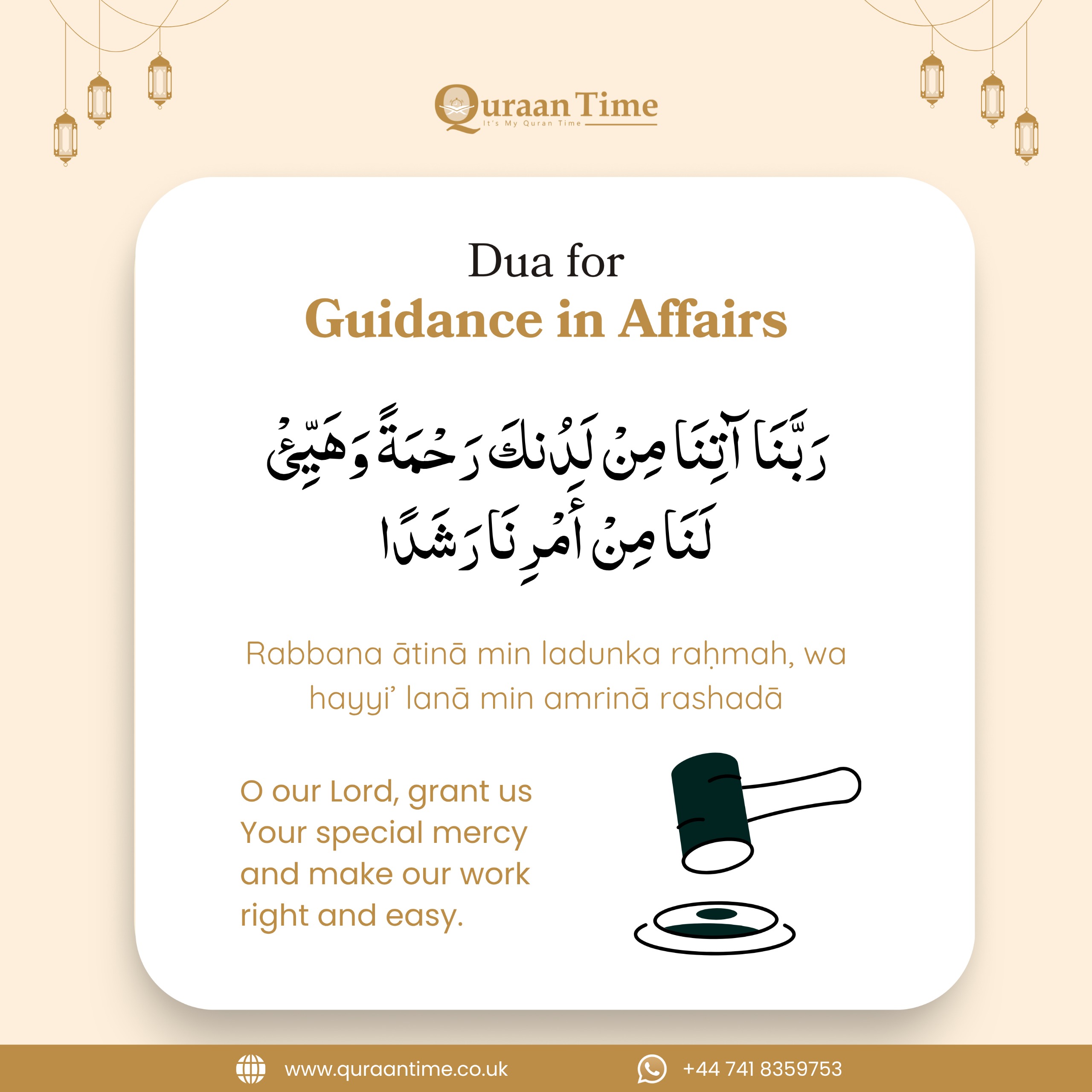
The word رَشَدًا (rashadā) signifies not just ordinary guidance but the highest form of intellectual, moral, and spiritual rectitude. When you recite this dua, you are asking Allah to align your heart, your decisions, and the outcomes of your affairs with divine wisdom. Unlike general duas, this supplication acknowledges human limitation — we may not know what is truly best, but the Creator of all affairs does. It is a dua of tawakkul (reliance) and active seeking of clarity, often recited before major life decisions, business ventures, family matters, or during confusion.
Islamic scholars highlight that the dua encompasses two essential gifts: mercy (rahmah) as a protective shield and inner light, and right guidance (rushd) as a practical compass. This combination ensures that not only does one make the correct choice, but they also receive Allah’s gentle care throughout the journey. Incorporating this dua in your morning and evening adhkar transforms uncertainty into serenity.
Reciting with presence unlocks inner stillness, reduces anxiety about the future, and sharpens decision-making skills.
From business to studies, 'hayyi’ lanā min amrinā' invites ease and removes hidden obstacles.
Aligning affairs with Allah’s will prevents the pain of wrong choices; you trust the divine outcome.
The Prophet’s companions taught that seeking 'guidance in affairs' is a sunnah of the prophets. In today’s overstimulated world, we face infinite options — career paths, marriage proposals, financial investments, parenting styles. This dua recenters the heart: "O Allah, arrange my affairs in a way that leads to righteousness." It’s not about passivity; rather, it energizes you to take action while trusting the ultimate disposer. Recite after obligatory prayers or during sajdah, and witness how doors open with unexpected khayr (goodness). Many Islamic teachers recommend it as a complementary practice to Salat al-Istikharah, perfect for ongoing situations requiring sustained wisdom.
Moreover, the structure of the dua itself teaches humility: 'min ladunka' (from Yourself) — we admit that true mercy and success come only from Allah. The second part 'hayyi’ lanā' (prepare for us / make easy for us) conveys a beautiful trust: You make crooked paths straight. No wonder this supplication became a daily anchor for early Muslim communities facing trials.
Beyond recitation, reflect on the meaning before sleeping. Imagine Allah preparing your affairs like a gentle tailor adjusting a garment. When you face a crossroads — whether it’s a job interview, a marriage proposal, a health decision — recite “Rabbana ātinā min ladunka raḥmah” and breathe deeply. Then proceed with confidence. The Prophet ﷺ said, “The dua of a Muslim for his brother in his absence is readily answered.” So also recite for family, colleagues, and the Ummah. The cumulative effect multiplies blessings. Over time, you’ll notice how previous hardships become stepping stones to wisdom — that’s the taste of ‘rashad’ manifesting.
To make it a living habit: tie it to daily triggers — after each adhan, before starting the car, before opening emails. Write it on a sticky note at your workspace. The beauty of this supplication is its brevity yet oceanic depth. Many spiritual masters (ahl al-tasawwuf) considered it a complete prayer for worldly and afterlife success because it asks for mercy (covering both worlds) and right guidance (which leads to Paradise). Let this dua be your compass today and every day.