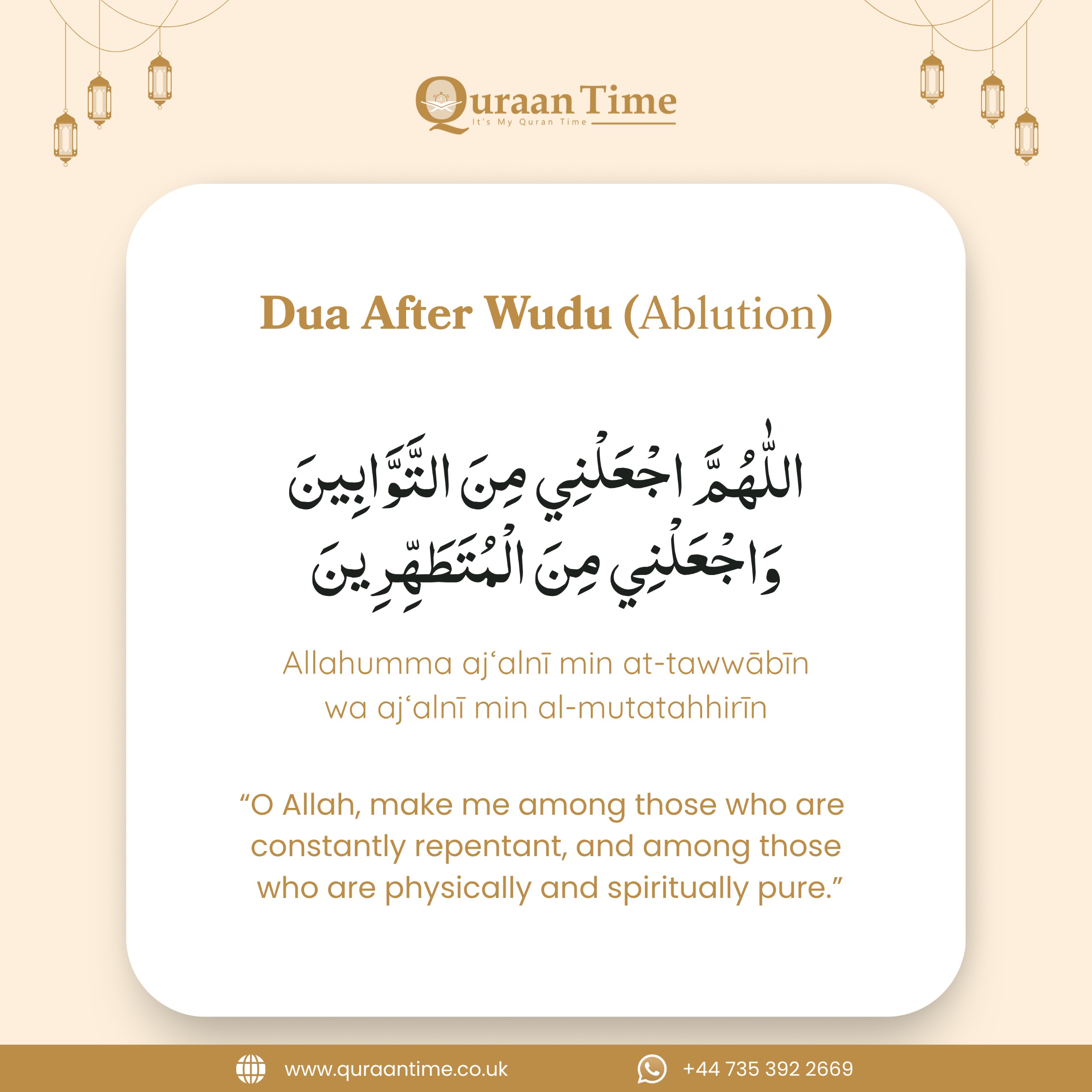
اللّٰهُمَّ اجْعَلْنِي مِنَ التَّوَّابِينَ وَاجْعَلْنِي مِنَ الْمُتَطَهِّرِينَ
Allahumma aj'alni minat-tawwabeena waj'alni minal-mutatahhireen
"O Allah, make me among those who turn to You in repentance and make me among those who purify themselves."
The Spiritual Significance of This Dua
Dual Purification: This beautiful supplication encompasses both spiritual repentance (tawbah) and physical purification (taharah), addressing the complete cleansing of a Muslim.
Continuous Renewal: By reciting this dua after wudu, Muslims acknowledge that purification is not just a physical act but a spiritual renewal of their commitment to Allah.
Comprehensive Cleanliness: The dua emphasizes that true purification involves both the outward cleaning of the body and the inward cleansing of the heart through sincere repentance.
Common Questions About Wudu and Its Dua
When exactly should this dua be recited after wudu?
This supplication is recommended to be recited immediately after completing the wudu, before it is broken. The optimal time is right after saying the Shahadah ("Ashhadu an la ilaha illallah...") that follows the completion of wudu. Many scholars recommend making this dua while still in the place where wudu was performed.
Is this dua mentioned in authentic hadith sources?
Yes, this dua is found in authentic collections. It is reported in Sunan At-Tirmidhi where the Prophet Muhammad (peace be upon him) taught this supplication to be recited after wudu. The hadith is classified as hasan (good) by scholars, making it a recommended practice with solid foundation in the Sunnah.
Can children be taught this dua, and at what age?
Absolutely. Children can begin learning this dua as soon as they start performing wudu, typically around age 7. The best approach is to recite it with them after their wudu, making it a natural part of the purification process. Repetition and positive reinforcement help children memorize and understand its importance gradually.
What is the deeper meaning behind asking to be among "those who purify themselves"?
The phrase "mutatahhireen" (those who purify themselves) encompasses multiple dimensions. It includes physical purification through wudu and ghusl, spiritual purification through avoiding sins and seeking forgiveness, and moral purification through good character and intentions. It's a comprehensive request for cleanliness in all aspects of life - body, heart, and actions.
How can parents make learning this dua engaging for children?
Parents can use several effective methods: create colorful visual aids with the Arabic text and translation, use repetition through games or rewards, associate the dua with the wudu routine consistently, explain the meaning in simple terms children understand, and most importantly, lead by example by reciting it themselves after every wudu.
What if I forget to recite this dua after wudu?
If you forget to recite this dua after wudu, your wudu remains valid as the dua is a recommended Sunnah, not an obligatory part of wudu. You can still recite it later when you remember, though the preferred time is immediately after completing wudu. The mercy of Allah is vast, and He rewards us for our intentions and efforts.