

When rainfall descends, the Prophet Muhammad (peace be upon him) taught a profound supplication that acknowledges Allah’s blessings. This article explains the authentic Dua, its meaning, spiritual benefits, and includes dialogues between teachers and parents to help instill this beautiful practice in children.
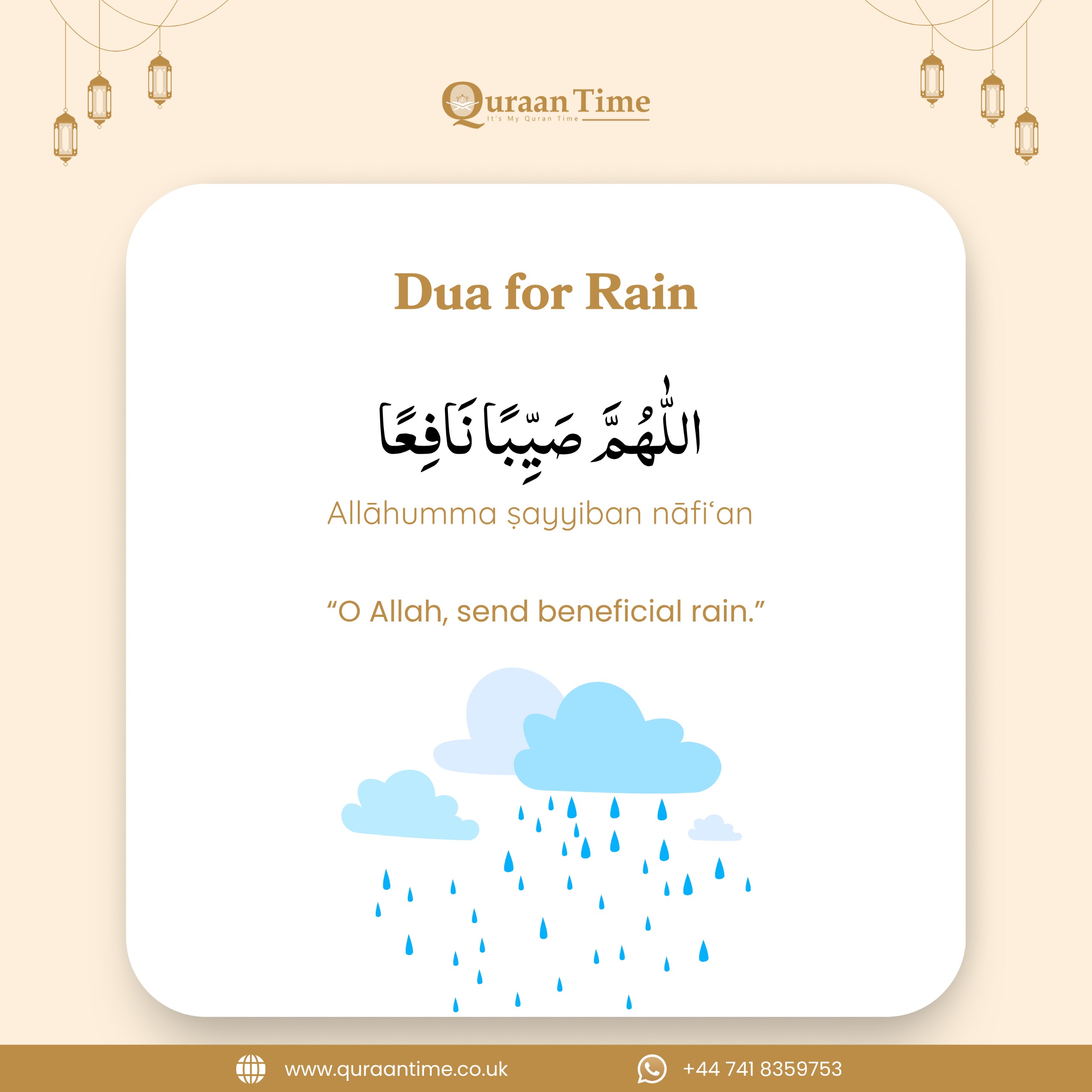
Meaning & Translation:
“O Allah, [send] beneficial rain.” or “O Allah, make it a beneficial downpour.”
(Narrated by Bukhari and others – when the Prophet ﷺ saw rain, he would say this.)Practical ways to teach children the Dua for rain and deepen their connection with nature’s blessings.
Parent Hassan: I’ve often wondered the same. Our children ask: “Why can’t we just say ‘thank you Allah’?”
Teacher Amina: Great point. The Prophet ﷺ taught us this precise wording because it asks for beneficial rain – one that nurtures crops, fills wells, and avoids harm. Saying “Allāhumma ṣayyiban nāfi‘an” is comprehensive: it acknowledges Allah as the sender and requests a specific outcome (benefit). It’s a beautiful fusion of gratitude and foresight. Parents can encourage children to memorize it during rainy days, turning weather into a learning moment.
Teacher Yusuf: Absolutely. Even at age 4-5, kids can repeat short phrases. Start by saying the Dua aloud when rain is visible. Repeat it softly and make a game: “Let’s ask Allah together for the rain to help the flowers and trees.” The key is linking action (rain) with the phrase. Older children (7+) can learn the meaning, and even write it in a ‘Ramadan/Islamic notebook’. Consistency is magical.
Parent Sarah: Would you suggest an activity? We have a rainy season approaching.
Teacher Yusuf: Yes! Create a “Rain Journal”. Every time it rains, your child recites the Dua and draws or writes something they are grateful for. This internalizes the spirituality and makes dua a joyful habit.
Parent Omar: I’ve read that it protects from harmful downpours, but is there scientific or psychological wisdom?
Teacher Khadija: Indeed, the Dua brings mindfulness. Psychologically, focusing on a positive supplication reduces anxiety about unpredictable weather. From an Islamic perspective, it is a means of attaining Allah’s mercy and warding off destruction (like floods, disease). The Prophet ﷺ also used to say this when rain intensified, reminding us to trust Allah’s decree. Children learn emotional regulation by turning to prayer during storms rather than fear. Plus, rain is a sign of divine mercy (Quran 30:48), so remembrance elevates gratitude.
Teacher Ibrahim: Great follow-up. After reciting the Dua, the Sunnah encourages us to let the rain fall on us (expose part of the body to it, if convenient) as the Prophet ﷺ did. Also, one should make additional personal Duas for the Ummah, for farmers, and for those affected by drought. Parents can teach children to say “Ameen” and to thank Allah for every drop. Another practice: Do not curse the wind/rain but always ask for goodness. This enhances tawakkul (reliance on Allah).
Parent Fatima: So we combine the Dua with acts of charity? I love that.
Teacher Ibrahim: Exactly. Rain is a mercy, and mercy prompts generosity. Even a small act of kindness after rainfall is highly rewarding.
Water is the essence of life, and rain represents divine compassion. The Quran declares: “And We send down from the sky blessed water” (Qaf 50:9). The Prophet ﷺ nurtured an appreciative heart; whenever rain fell, he would uncover his shoulder to feel the raindrops and recite “Allāhumma ṣayyiban nāfi‘an”. This dua is concise yet profound: a recognition that all benefit comes from Allah alone.
Scholars explain that “ṣayyib” refers to a pouring rain that spreads across the land, and “nāfi‘an” means beneficial – absent of destruction, flood, or disease. By reciting this Dua, a believer aligns with the prophetic tradition and attracts goodness. In many Muslim cultures, families open windows, gather children, and recite this Dua together, turning a weather event into a spiritual family moment. Teaching children this Dua at a young age reinforces tawheed (Oneness of Allah) and a positive outlook on natural phenomena.
Moreover, the Dua for rain subtly teaches reliance on Allah while taking practical measures: farmers rejoice at rain, travelers pause in awe, and communities are reminded to thank the Provider. Islamic tradition also mentions that when rain falls, it is a time when Duas are readily accepted, as the Prophet ﷺ said: “Two supplications are not rejected: the supplication at the time of the call to prayer and at the time of rain.” (Al-Hakim). This adds immense value: after reciting “Allāhumma ṣayyiban nāfi‘an”, you can also supplicate for personal needs, forgiveness, or the well-being of family.
Throughout history, Muslim scholars dedicated chapters in Hadith collections to “The Book of Rain and Istisqa” (prayer for rain). The brevity of this Dua makes it extremely easy for parents to embed into daily routine: after hearing thunder, before stepping into rain, or even while driving through showers. Encourage children to repeat after parents, reinforcing correct pronunciation. Some families create a ‘Dua for Rain’ poster with Arabic calligraphy. This not only promotes Islamic literacy but also beautifies the home environment, echoing the secondary color #E7D2B6 as a warm, comforting background. The primary golden-brown #BC8D46 symbolizes the earth after rain, fertile and hopeful.
Reminder from Sahih Bukhari: It was narrated that Anas (RA) said: “It rained upon us while we were with the Messenger of Allah ﷺ, so he uncovered his garment until the rain fell on him. We said: ‘O Messenger of Allah, why did you do that?’ He said: ‘Because it (rain) is a recent covenant with its Lord.’” Then he recited the Dua. This tradition shows respect and love for Allah’s blessing.
When integrated into modern homeschooling or weekend Islamic classes, teachers can use the Dua for Rain to discuss the water cycle from an Islamic lens: “Allah sends winds, then clouds, then rain (Quran 35:9)”. Parents may lead a rainy-day craft: children write “Allāhumma ṣayyiban nāfi‘an” on a cloud-shaped paper. Additionally, during continuous heavy rains, one should recite this Dua multiple times and avoid statements of discontent like “the rain is bad”. Instead, we say: “O Allah, bring benefit and keep us safe.” This Dua shapes an optimistic mindset. Teachers & Parents cooperation is vital — such dialogues strengthen communal learning and deepen understanding. Whether you are an adult who just discovered this beautiful supplication, or a parent raising mindful children, reciting “Allāhumma ṣayyiban nāfi‘an” each time the sky pours is a gateway to countless blessings. May Allah accept our Duas and grant us beneficial rain.