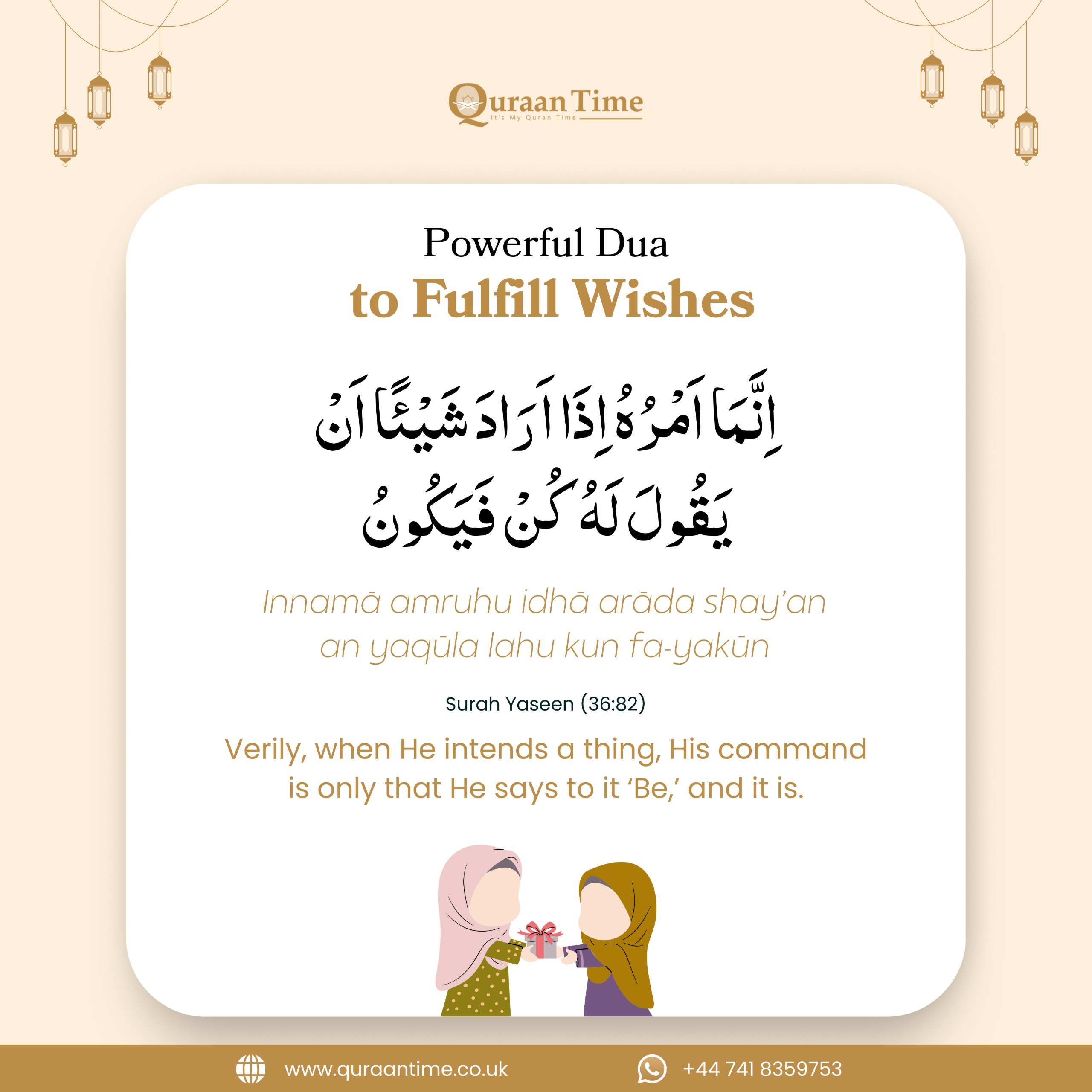
🌟 The Profound Meaning of "Kun Faya Kun"
The verse “Innama amruhu…” from Surah Yaseen is one of the most powerful declarations of Allah’s absolute authority over creation. It highlights that when Allah wills something to happen, His command is simply the word “Be” (Kun), and it instantly comes into existence. This divine principle applies to everything in the universe — from the creation of the heavens and earth to the fulfillment of a sincere believer’s lawful wish. Reciting this Dua with deep conviction reminds us that no obstacle is too great for the Creator. The verse encourages reliance on Allah’s infinite power and teaches us that our wishes are fulfilled not by material means alone but by the permission and decree of the Almighty.
Scholars explain that the repetition and contemplation of this Ayah strengthen Tawakkul (trust in God). When a person sincerely recites this Dua for a specific wish — whether related to health, provision, marriage, or success — they align their heart with the reality that Allah’s creative command transcends natural laws. Unlike human beings who need tools and time, Allah’s command is timeless and immediate. This powerful Dua to fulfill wishes is not magical incantation, but a spiritual act of surrendering to the One Who says “Kun” and it becomes. The early Muslims would recite this verse during moments of extreme difficulty, knowing that the same power that created the universe can transform their situation in the blink of an eye.
✨ How to Practice This Dua for Wish Fulfillment
To harness the barakah (blessings) of this verse, spiritual teachers recommend the following etiquettes: perform a fresh ablution (wudu), face the Qibla, and with a present heart recite Surah Yaseen entirely or at least recite Ayah 82 repeatedly (7, 11, or 41 times) while visualizing your wish already manifested. After each recitation, send Salawat upon Prophet Muhammad (peace be upon him). Then raise your hands in sincere supplication (dua), asking Allah by the majesty of this verse to grant your specific need. Consistency and certainty are key — never doubt that Allah’s command “Be” is enough. It is also highly recommended to give charity (sadaqah) before or after reciting the dua, as charity accelerates the acceptance of prayers.
Many Islamic spiritual guides note that reciting this verse 100 times after Fajr or Tahajjud prayer yields extraordinary results. The phrase “Kun faya kun” is the ultimate reminder that Allah’s will supersedes every barrier. Whether you seek healing from illness, relief from debt, guidance for confused heart, or reunion with loved ones, recite with conviction: “O Allah, You said to something ‘Be’ and it is. So I ask You by Your complete power to grant my wish and make it easy for me.” Additionally, writing the verse with saffron on a clean plate, washing it with rose water, and drinking the water with the intention of wish fulfillment is a traditional practice among some saints (always with pure tawheed). However, the core remains sincerity and belief in Allah’s supreme ability.
It is essential to combine this powerful dua with lawful effort (asbab). If your wish is to find a righteous spouse, actively seek while reciting; if you desire a job, apply with excellence. The dua opens doors from the Unseen and aligns divine decree with your action. Moreover, do not be impatient — Allah responds in the perfect timing. Sometimes a wish is delayed because Allah wants to replace it with something better or remove a hidden harm. The believer’s attitude should be gratitude regardless of the immediate outcome, knowing that “Kun faya kun” is a declaration of Allah’s sovereignty, and He is the Most Wise.
This Dua is particularly powerful when recited during the last third of the night, on Fridays, or between Adhan and Iqamah. Surah Yaseen is often called “the heart of the Quran,” and its central verse (36:82) carries immense spiritual weight. Countless stories from Islamic tradition speak of impossible wishes being granted — barren women conceiving, debts cleared miraculously, and travelers protected — all through the barakah of this divine statement. Embrace this practice with pure intention, and witness how Allah’s command transforms your reality.
💬 Q&A: Teachers & Parents Discuss the Powerful Dua
📌 Teacher Umm Zakariya:
Question to parent: “As a parent, how can I teach my children the concept that Allah’s command 'Be' is enough to fulfill any wish? My child sometimes loses hope when prayers aren't answered immediately.”
Parent Answer (Brother Ahmed): “I explain the verse of Kun faya kun using simple examples — like how Allah created the mountains, trees, and even our own existence with just a command. I tell my child that dua is like planting a seed; sometimes it grows fast, sometimes slowly, but Allah's power never fails. We also keep a ‘wish journal’ where we write the dua together and watch how Allah opens doors in unexpected ways. Repetition of Surah Yaseen’s verse before sleep makes the child's heart firm.”
📌 Teacher Sr. Fatima (Islamic School):
Parent asks: “Is it permissible to recite this Dua for worldly wishes like a new house or career success? Some scholars say dua should be mainly for hereafter.”
Teacher’s response: “Absolutely permissible. The Prophet (PBUH) taught us to ask Allah for both worldly and spiritual good. The verse ‘Kun faya kun’ covers all lawful wishes. However, the intention should be that the wish helps you become closer to Allah — for example, a house to establish a peaceful family that worships Allah, or a career to give charity and support your dependents. When you recite the dua, blend your worldly need with a higher purpose. Allah loves when His servants ask Him for everything, big or small. So yes, use this powerful dua for any halal need, and add ‘O Allah, grant me that which is best for my deen and dunya.’”
📌 Concerned Parent (Sister Amina):
Teacher’s question: “How can we ensure our children don't fall into thinking the dua is magic? I want them to understand reliance on Allah.”
Teacher’s answer (Ustadh Hisham): “Great concern! The key is to always link the dua to the belief in Qadr (divine decree). Teach that the words ‘Kun faya kun’ reflect Allah’s power, but we still must take action. Example: if a student wants to pass exams, he recites this dua AND studies diligently. Similarly, parents should remind kids that dua is worship and sometimes Allah delays the answer because He knows best. Use stories of Prophet Musa (AS) — his prayer was answered after years. This balances hope, action, and trust. We never treat the verse as a formula but as a declaration of Allah’s might.”
📌 Teacher Brother Khalid:
Parent question: “What if after reciting this Dua for months my specific wish isn't fulfilled? Does it mean it's not accepted?”
Teacher’s reply: “No, never! The Prophet (PBUH) said: ‘The supplication of any one of you is granted so long as he does not become impatient.’ Either Allah grants the exact wish, removes an equivalent harm, stores the reward for the Hereafter, or gives something far better. I recall a parent who prayed for a child’s recovery but instead the child was granted immense spiritual rank. Trust that Allah’s ‘Kun’ is always working for your ultimate good. Continue reciting with gratitude and contentment. Many times, the wish is transformed into a greater blessing you never imagined.”