
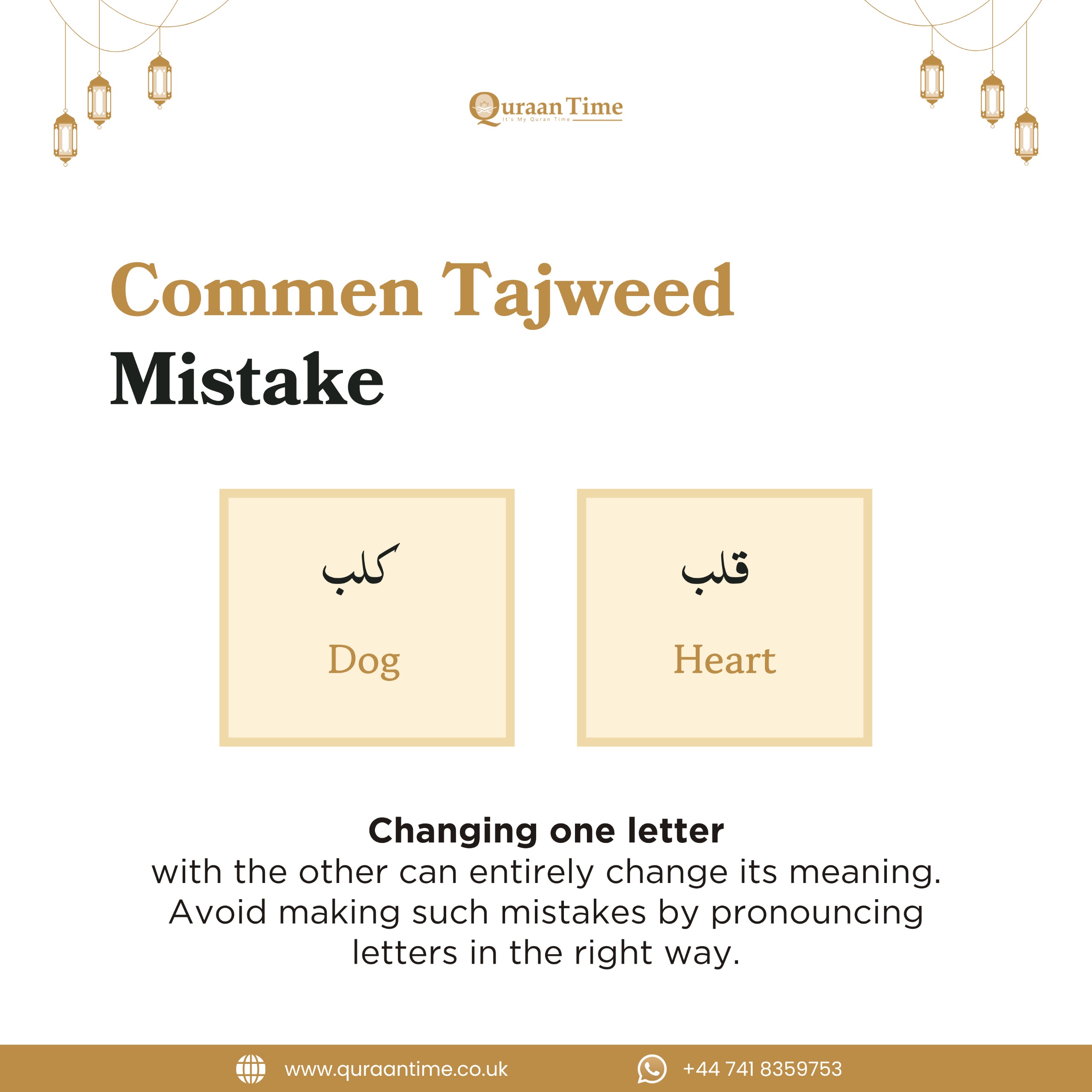
Among the most pervasive errors among non-native Arabic speakers and even some heritage learners is the混淆 between heavy (tafkheem) and light (tarqeeq) letters. The pair ق and ك exemplifies this perfectly. The letter ق (Qaf) is classified as a musta‘liyah (elevated) letter, requiring the back of the tongue to rise towards the palate, producing a deep, emphatic echo. In contrast, ك (Kaf) is pronounced with the same point of exit but without the elevation—yielding a lighter, thinner sound. When a student recites “qalb” as “kalb”, the meaning shifts from “heart” — the seat of faith and consciousness — to “dog,” an animal. In verses describing the believers’ hearts or the story of the sleepers in the cave, such a mistake becomes a catastrophic semantic distortion. The Qur’an warns in Surah Al-Isra 17:84: “Say, each works according to his manner.” Our manner must include mastering letters with care.
Letters like ض-ظ, س-ص, ت-ط frequently cause meaning shifts. Tajweed clinics record over a dozen recurring pairs.
Research among online Quran circles shows that 85% of beginners require structured articulation training for Qaf and Kaf distinction.
Halq (throat) letters: Aqsal halq (deepest), wasat al halq (middle), adnal halq (closest). Qaf & Kaf share origin but differ in sifaat.
Rectifying entrenched tajweed mistakes requires a multi-sensory approach. Visual diagrams of the mouth, repeated listening to master reciters like Al-Husary or Al-Minshawi, and mirror exercises help students internalize the difference. Teachers recommend minimal pair drills: recite pairs such as قمر (moon) vs كمر (waist), قبر (grave) vs كبر (greatness). Recording oneself and comparing with a certified instructor’s pronunciation yields rapid improvement. Additionally, understanding the attributes (sifaat) like istifaal (lowness) vs isti‘laa (elevation) cements the distinction. Institutions like Qurantime employ structured curricula focusing on error mapping—each student receives personalized exercises targeting their specific confusion points. Over time, muscle memory forms, and the tongue naturally gravitates to the correct makhraj.
Listen and repeat the distinct sounds. Click each button to hear simulated articulation guidance (text-to-speech). Compare Qaf and Kaf side by side.
While the ق-ك confusion stands as a poster child for makharij mistakes, other subtle errors include mixing ض (Dad) with ظ (Zah) which transforms “al-dhaalleen” (those who go astray) into a meaningless utterance. Similarly, merging س (Seen) with ص (Sad) alters words like “sirat” (path) which must be recited with a clear ṣād in Al-Fatihah. The ripple effect of such mistakes can disrupt the rhythm, meaning, and spiritual experience of prayer. Professional tajweed programs dissect each letter family—Al-Jawf, Al-Halq, Al-Lisaan, Ash-Shafataan—ensuring students master not only points of articulation but also inherent characteristics like Jahr (vocalization) and Hams (whisper).
For parents seeking to support their children, incorporating fun games like “Find the heavy letter” in a verse and using color-coded Qurans (with tajweed rules) accelerates recognition. Teachers advise daily 5-minute focused practice on a single letter pair until it becomes second nature. Moreover, attending live online circles with real-time correction remains the gold standard. At Quraan Time Institute, classes integrate theory with application—learners practice with native-level instructors who pinpoint errors instantly, offering customized drills.
Begin your journey to flawless recitation today
Visit: www.quraantime.co.uk | Call / WhatsApp: +44 741 8359753
One-to-one Tajweed correction | Ijazah programs | Children & Adults