

What Is Tajweed? The Art of Beautiful Qur'an Recitation
A comprehensive guide to understanding Tajweed, its importance in Qur'an recitation, and how to learn this sacred science properly.
Understanding Tajweed
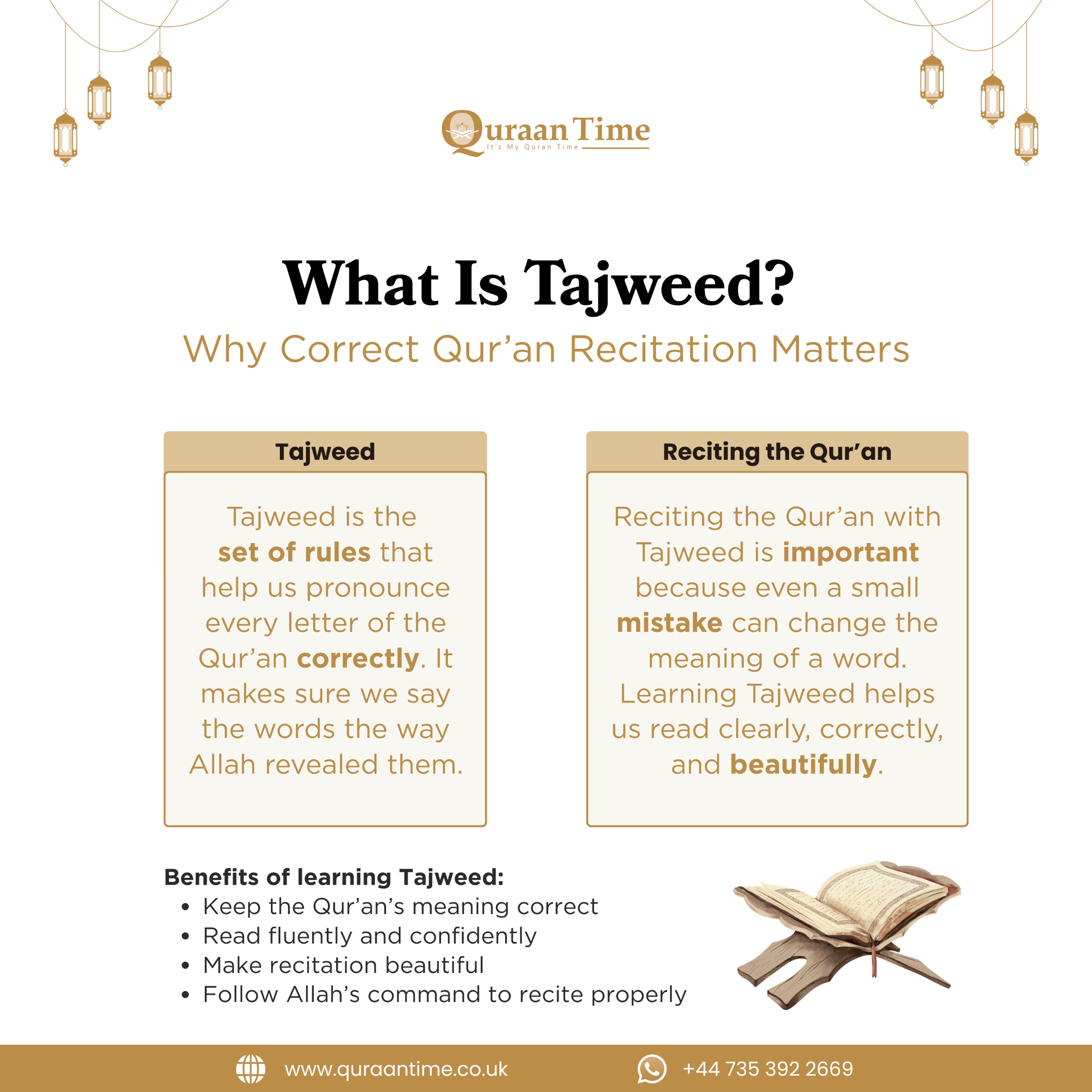
Tajweed (تَجْوِيد) is the science of reciting the Qur'an correctly by giving every letter its right and due in pronunciation. Derived from the Arabic root "Ja-wa-da" meaning "to make well, to improve," Tajweed encompasses the set of rules that govern how the Qur'an should be articulated.
Why Tajweed Matters
Reciting the Qur'an with Tajweed is not merely a stylistic choice but an obligation upon every Muslim. The Qur'an is the literal word of Allah, revealed in Arabic with specific pronunciation rules. Applying Tajweed ensures we recite the Qur'an exactly as it was revealed to Prophet Muhammad (peace be upon him), preserving its meaning and beauty.
Tajweed rules cover all aspects of Qur'anic recitation including correct pronunciation of letters, proper elongation, nasalization (ghunnah), and characteristics of letters (sifaat). Learning Tajweed transforms recitation from simple reading to a spiritually uplifting act of worship.
Benefits of Learning Tajweed
Mastering Tajweed offers both spiritual and practical benefits that enhance your relationship with the Qur'an:
Preserve Meaning
Prevents mistakes that could change the meaning of Allah's words, ensuring accurate understanding.
Beautiful Recitation
Transforms your recitation into a melodious, heart-touching experience for both reciter and listener.
Confident Reading
Builds confidence in Qur'an recitation during prayer, study circles, and teaching others.
Spiritual Fulfillment
Deepens connection with Allah through proper recitation of His divine words.
Common Questions About Tajweed
Here are answers to frequently asked questions from parents and students about learning Tajweed:
Answer: According to Islamic scholars, learning Tajweed is fard kifayah (communal obligation) - meaning that at least some Muslims in the community must know it. However, applying Tajweed rules while reciting is fard 'ayn (individual obligation) on every Muslim to avoid major mistakes that change meanings.
- Based on classical Islamic scholarship and contemporary fatwas
Answer: Yes, children are actually excellent candidates for learning Tajweed. Their minds are receptive to pronunciation rules, and starting early creates a strong foundation. Many Tajweed teachers recommend beginning around age 7-8 when children have basic reading skills. The key is finding age-appropriate teaching methods that make learning engaging.
- Experience from Qur'an teachers and Islamic educators
Answer: The timeline varies based on several factors: prior knowledge of Arabic, consistency in practice, quality of instruction, and individual aptitude. Generally, with consistent study (3-5 hours per week), students can grasp the basic rules in 3-6 months. Mastery, however, is a lifelong journey as even scholars continue refining their recitation.
- Curriculum analysis from Tajweed institutes worldwide
Answer: The most frequent mistakes include: improper pronunciation of heavy and light letters (tafkheem and tarqeeq), incorrect elongation (madd), missing nasal sounds (ghunnah), and not observing stops (waqf). Many of these errors don't change meaning but affect the beauty and correctness of recitation.
- Common errors identified by Qur'an competition judges
Key Tajweed Concepts at a Glance
Articulation points of letters
Characteristics of letters
Merging of letters
Hidden pronunciation
Proper elongation
Rules of stopping
Begin Your Tajweed Journey Today
Whether you're a complete beginner or looking to refine your recitation, start learning Tajweed with proper guidance. Consistent practice with a qualified teacher is the key to success.
Find a Tajweed Teacher