
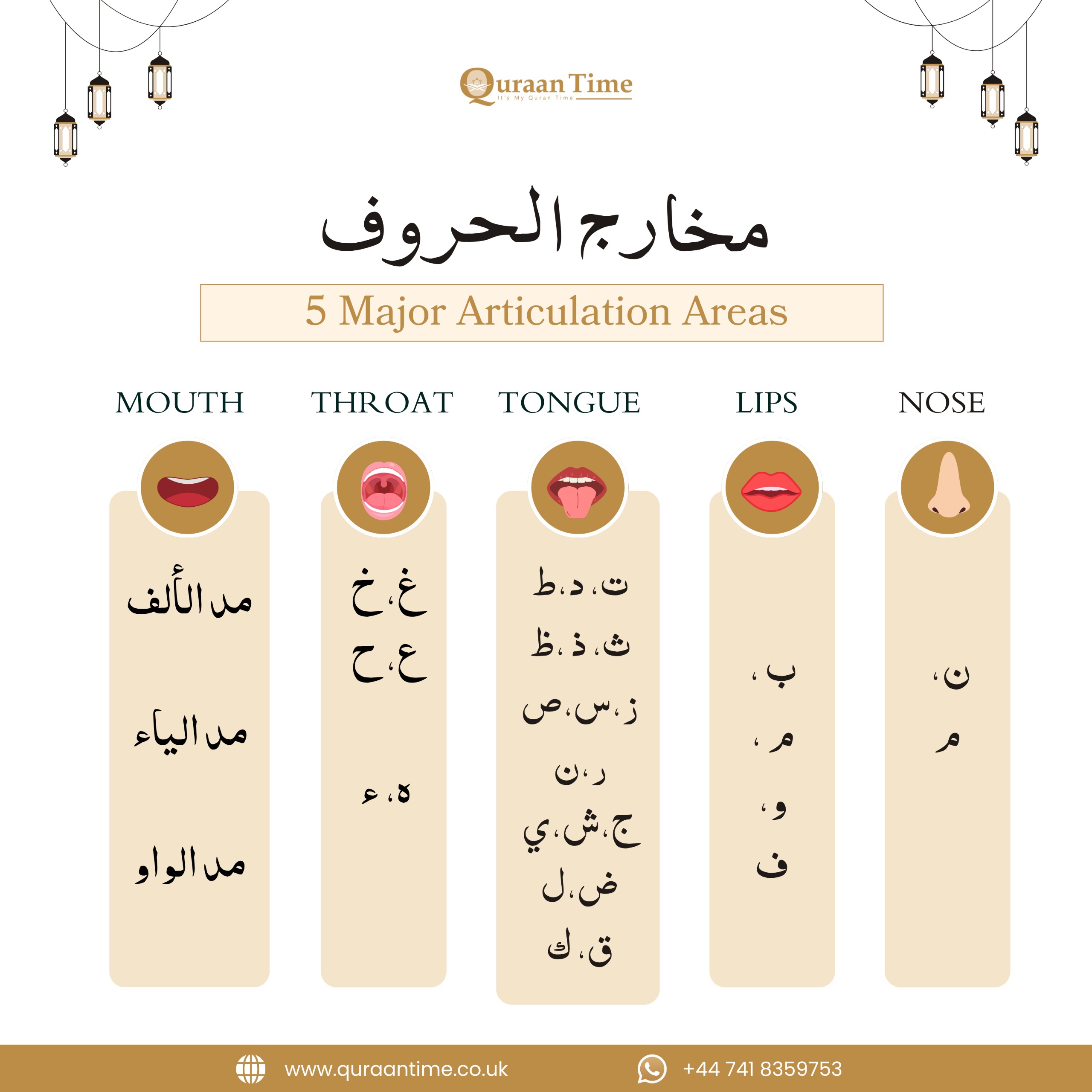
In the science of Tajweed, understanding the five major articulation areas is fundamental to recite the Quran and classical Arabic with precision. Each letter emerges from a specific makhraj (articulation point). The five primary regions: Throat (Al-Halq), Tongue (Al-Lisan), Lips (Ash-Shafatan), Nasal Cavity (Al-Khayshum), and Empty Oral Space (Al-Jawf) shape every phonetic nuance. Mastering these zones eliminates common errors, enhances clarity, and preserves the beauty of Arabic recitation. For teachers and parents, guiding children through interactive methods builds strong foundational skills. Below we explore each area in detail, provide letter examples, and answer real classroom questions.
Deepest throat: ء, ه (Hamzah, Haa)
Mid throat: ع, ح (Ayn, Haa)
Closest to mouth: غ, خ (Ghayn, Khaa)
These letters require throat muscle control. Essential to differentiate between similar sounds like ح and ه.
Ten distinct points: from tip to back produce ق, ك, ج, ش, ض, ل, ن, ر, ط, د, ت, ص, س, ز, ظ, ذ, ث. The tongue touches palate, teeth ridges, and gums.
Examples: قاف (ق) from deepest tongue, نون (ن) from tip, ضاد (ض) from sides.
Two main exits: inner lips (between both lips) → ب, م, و and outer labiodental edge → ف (touching lower lip with upper teeth).
The letter و requires lip rounding, while م and ب use complete lip closure.
Not an independent letter exit but the origin of nasalization. Ghunnah occurs with ن and م when shaddah or in specific rules (ikhfaa, iqlab). Sound resonates in the nasal cavity.
Essential for Tajweed: prolonged nasal sound (2-3 counts) appears in noon and meem mushaddadah.
Al-Jawf is the empty space inside the mouth and throat. From here, three madd letters emerge: ا (Alif Maddiyyah), و (Waw Maddiyyah), ي (Yaa Maddiyyah) without any obstruction.
These prolong vowels: Alif after fathah, Waw after dhammah, Yaa after kasrah.
Understanding the five articulation areas transforms how teachers and parents correct mispronunciations. For instance, mixing ح (from throat) with ه (from larynx) changes meaning entirely. The tongue's precision affects letters like ص vs س. Children learn faster when they visualize the articulation map: throat letters resemble “whispering from inside”, lip letters require pouting, nasal ghunnah feels like vibration on the nose bridge. Daily drills like repeating أ، إ، ع، ح while touching the throat builds muscle memory. Also, the Jawf madd letters should be prolonged naturally — a core rule of Tajweed. This comprehensive knowledge elevates fluency and fosters love for accurate Quranic recitation.
Additionally, phonetic exercises help non-Arabic speakers: use a mirror to observe lip shape for و and ف, or pinch your nose to feel the difference between nasal and oral sounds. With over 29 Arabic letters distributed among these five regions, mastering Makharij is the gateway to tajweed mastery. The following Q&A session addresses common challenges that parents and teachers face during instruction.