The Significance of Kalimah Tamjeed
The Third Kalimah, known as Kalimah Tamjeed (Word of Glory), is a fundamental declaration in Islamic teachings that emphasizes the magnificence, power, and uniqueness of Allah. This sacred phrase serves as a constant reminder of Allah's supreme authority and our complete dependence upon Him.
Teaching this Kalimah to children is not merely about memorization; it's about instilling taqwa (God-consciousness) and cultivating a heart that recognizes Allah's greatness in every aspect of life. The Kalimah Tamjeed consists of several profound components:
- Subhanallah - Glory is to Allah
- Alhamdulillah - All praise is for Allah
- La ilaha illallah - There is no god but Allah
- Allahu Akbar - Allah is the Greatest
- La hawla wa la quwwata illa billah - There is no power nor strength except with Allah
Each segment carries deep theological significance and when combined, they form a comprehensive declaration of faith that covers praise, glorification, monotheism, and acknowledgment of divine power.
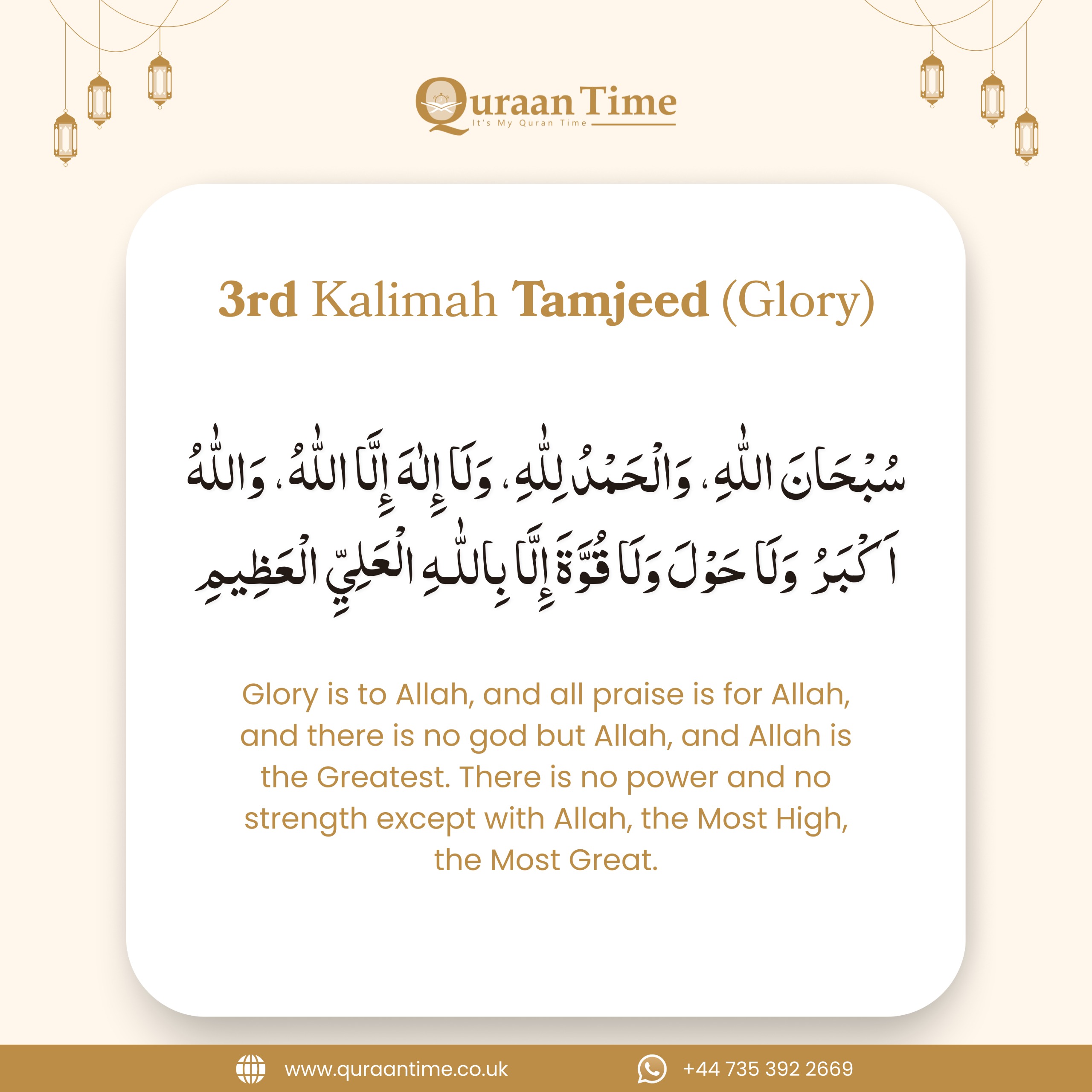
سُبْحَانَ اللهِ، وَالْحَمْدُ لِلَّهِ، وَلا إِلَهَ إِلاَّ اللهُ، وَاللهُ أَكْبَرُ، وَلا حَوْلَ وَلا قُوَّةَ إِلاَّ بِاللهِ الْعَلِيِّ الْعَظِيمِ
Translation: Glory is to Allah, and all praise is for Allah, and there is no god but Allah, and Allah is the Greatest. There is no power and no strength except with Allah, the Most High, the Most Great.
Common Questions About Teaching Kalimah Tamjeed
Parent: My child can recite the Kalimah but doesn't understand its meaning. How can I explain it in simple terms?
Teacher: Begin with analogies children understand. For "Allahu Akbar," compare it to something they consider big - "Allah is bigger than the biggest mountain, taller than the tallest building, and greater than anything we can imagine." For "La hawla wa la quwwata," explain it as "We need Allah's help for everything, just like plants need sunlight to grow." Use visual aids and simple stories from the Quran that illustrate these concepts.
Parent: At what age should I start teaching the meanings of the Kalimah?
Teacher: Children as young as 4-5 can begin understanding basic concepts. Start with "Subhanallah" when seeing something beautiful, "Alhamdulillah" when receiving something good, and "Allahu Akbar" when seeing something large or impressive. The full explanation can be gradually introduced between ages 7-10 as their cognitive abilities develop. Remember, consistency and positive reinforcement are more important than early age.
Parent: How can I make learning the Kalimah more engaging for my child?
Teacher: Create interactive activities: 1) Kalimah art project - write each phrase decoratively, 2) Role-playing scenarios where different phrases are used appropriately, 3) Memory games with flashcards, 4) Reward charts for daily recitation with understanding, 5) Relate each part to daily experiences - saying "Alhamdulillah" after meals, "Subhanallah" when seeing nature. The key is connecting the Kalimah to real-life situations.
Parent: My child asks why we say "no power except with Allah" if we have our own abilities. How should I respond?
Teacher: This is an excellent opportunity to teach tawheed (monotheism). Explain that our abilities are gifts from Allah. Use the analogy of electricity: "Just as a lamp needs electricity to shine, we need Allah's power to use our abilities. Our hands can write, but who gave them strength? Our minds can think, but who created them? This phrase reminds us that all our capabilities come from Allah and should be used in ways that please Him."
Parent: How often should children recite the Third Kalimah?
Teacher: Ideally, it should be part of their daily morning and evening remembrance (adhkar). The Prophet Muhammad (peace be upon him) recommended certain remembrances at these times. However, quality matters more than quantity. Encourage them to recite it with understanding at least once daily, perhaps after Fajr or before bedtime. As they grow older, they can incorporate it into their regular dhikr routine more frequently.
Educational Benefits of Learning Kalimah Tamjeed
Beyond spiritual development, teaching Kalimah Tamjeed offers several educational benefits:
Cognitive Development: The Kalimah introduces children to abstract theological concepts, enhancing their cognitive abilities. Memorizing Arabic text improves memory skills and linguistic awareness, especially for non-Arabic speakers who become exposed to a new language structure.
Emotional Regulation: Each phrase serves an emotional purpose. "Alhamdulillah" cultivates gratitude, "Subhanallah" develops awe and wonder, "La hawla wa la quwwata" teaches humility and dependence. Children learn to process different emotions through spiritual lenses.
Moral Foundation: The Kalimah establishes a moral compass based on divine consciousness rather than mere social compliance. Children learn that their actions are ultimately accountable to the Greatest Being, fostering intrinsic motivation for good behavior.
Cultural Connection: For Muslim children in non-Muslim majority countries, learning the Kalimah strengthens Islamic identity and connects them to a global community of believers who share these foundational declarations.